
























chronicle-2-0
AI presentations without the AI slop
Chronicle 2.0 Is Betting That Taste Is the Last Moat in AI Presentations
The Macro: The Slide Factory Problem Nobody Wants to Admit
Here’s the issue with AI presentation tools right now. They work. They produce slides. They do it quickly. And most of the output looks like it was assembled by someone who learned design from a 2019 webinar about “visual storytelling.”
The market itself is enormous and still growing. The global productivity apps market is valued at around $14.46 billion in 2026, according to Fortune Business Insights, and is projected to nearly double by 2034. Business productivity software broadly is on a similar trajectory, with Yahoo Finance reporting a projected jump from $62.5 billion in 2024 to $142.9 billion within the next decade. Presentations sit squarely inside both of those numbers.
The competitors in this specific corner are well-funded and well-known. Canva has moved aggressively into AI-assisted slides. Tome built a whole product around the concept before pivoting. Beautiful.ai, Pitch, and Gamma are all chasing the same basic pitch: let AI do the structure, let the human take credit for the output. Even PowerPoint and Google Slides have started bolting AI features onto their existing surfaces.
None of them have fully solved the slop problem.
That’s not an insult, it’s a product constraint. Generative AI is very good at pattern-matching and very bad at taste. It produces things that look like presentations more often than it produces things that look like good presentations. The difference is hard to define and even harder to automate.
This is the wedge Chronicle is trying to drive. Whether “AI without the slop” is a real product differentiator or a tagline that dissolves under scrutiny is the actual question worth asking. The pitch is everywhere right now. I’ve watched similar claims across AI productivity tools that promise genuine judgment rather than speed, and the pattern I keep seeing is that the claim is easy and the execution is brutal.
The Micro: What Chronicle Actually Does Differently (Or Tries To)
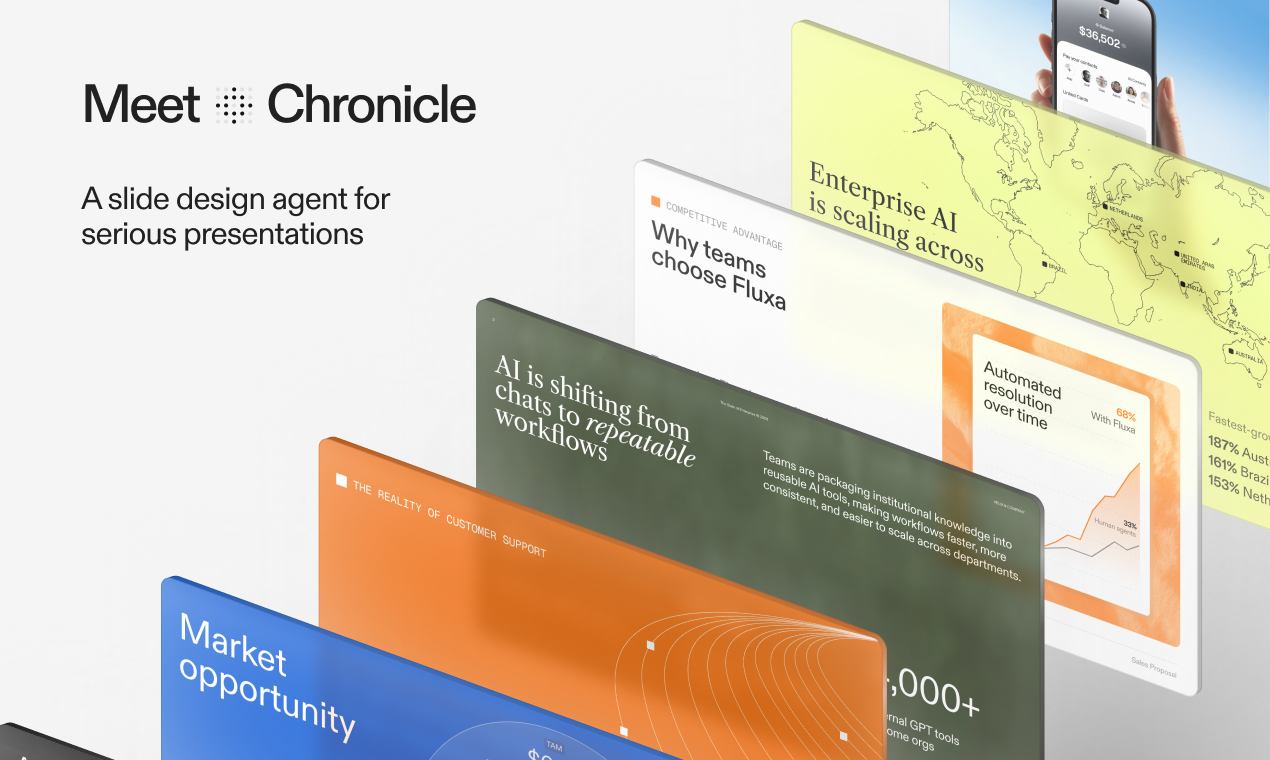
Chronicle 2.0 positions itself as an AI design partner specifically for business-critical presentations. The framing matters. They’re not chasing the student-making-a-class-project use case. Their homepage calls out sales proposals, pitch decks, business updates, research reports, product showcases, and project plans. That’s an intentional narrowing.
The product flow starts with you feeding it something. Notes, a prompt, or an existing deck. Chronicle asks clarifying questions before generating anything, which is a small but meaningful design choice. Most AI presentation tools skip this step entirely, optimizing for the dopamine hit of watching slides appear. Chronicle is explicitly trading some of that instant gratification for a better first draft.
The conversation-based refinement is where the product gets interesting. Rather than clicking through a UI of formatting options, you tell it what you want changed. The thesis is that editing through conversation is faster and less cognitively taxing than editing through menus. I think that’s probably right, though how well it works depends almost entirely on how good the model is at understanding what “make this feel more executive” actually means.
The brand says it’s trusted by 5,000-plus teams, with logos including OpenAI and Ramp on the homepage. Those claims come from Chronicle’s own marketing, so I’d treat them as directional rather than verified. It did well when it launched on Product Hunt, landing near the top of the day.
The “without the AI slop” tagline is doing a lot of work here. It’s a smart positioning move because it acknowledges the category’s existing reputation problem directly. It sets up an expectation, though. If the output still looks templated and generic, the gap between the promise and the product will be harder to forgive than it would be for a tool that never made the claim.
For anyone tracking how the AI productivity space is thinking about the agent layer underneath these tools, Chronicle’s current architecture sits at the more controlled end of the spectrum, which makes sense for high-stakes business documents.
The Verdict
Chronicle 2.0 is solving a real problem. The AI presentation space has a genuine quality ceiling right now, and there’s clear demand for something that doesn’t produce output that looks like clip art with better fonts.
The question is whether their solution is structurally different enough to hold. Asking clarifying questions before generating and allowing conversational refinement are both good ideas. They’re also the kind of good ideas that Canva or Gamma can ship in a quarter once they see users responding to them.
At 30 days, I’d want to know whether the output quality actually holds up across domains. Sales decks and pitch decks have very different visual conventions, and an AI that is great at one often struggles with the other.
At 60 days, I’d want to see whether the 5,000-plus teams claim translates into the kind of retention that makes a B2B SaaS business real. Teams adopting AI tools is easy. Teams making those tools a workflow dependency is the hard part, and it’s where most AI productivity bets either compound or stall.
The bet Chronicle is making is that taste is defensible. I hope they’re right. But taste is also the thing every design tool promises and few deliver consistently at scale. The tagline is a contract with the user. The product has to cash it.