














typeboost-2
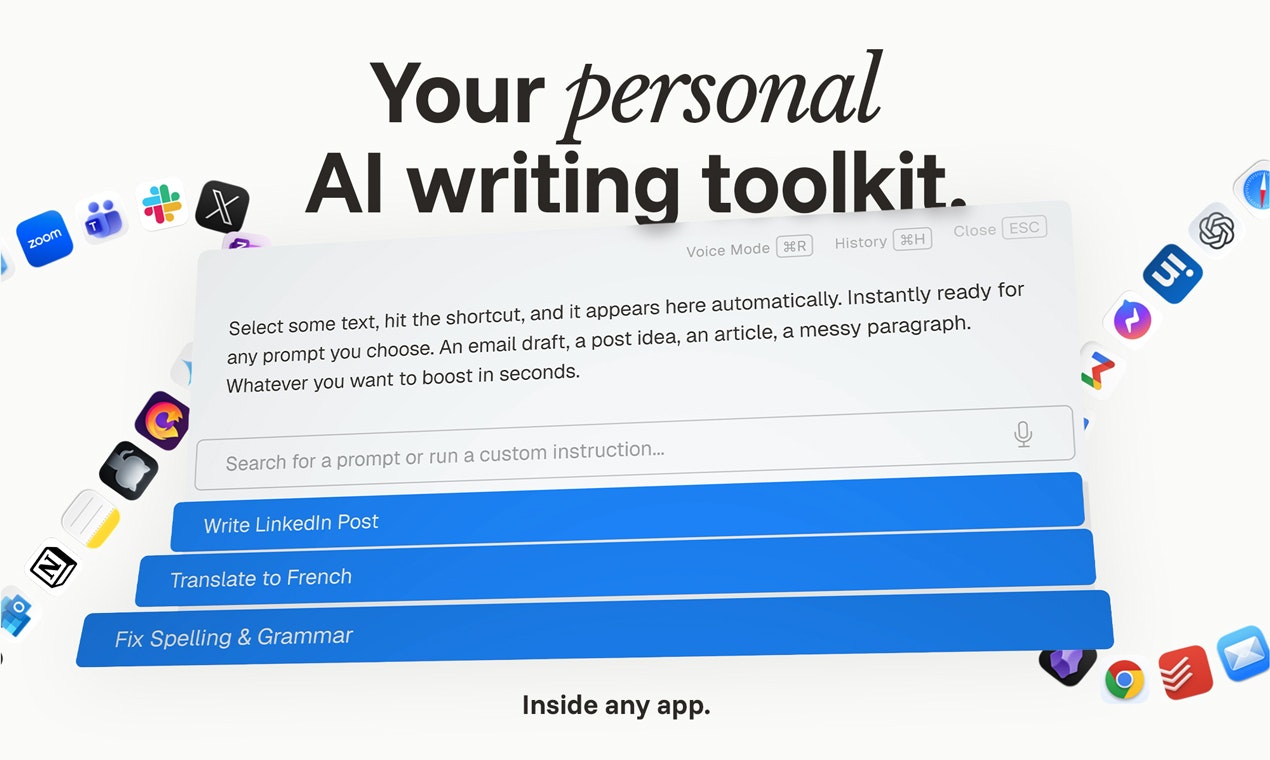
Your personal AI writing toolkit. Inside any app.
TypeBoost Wants to Be the AI Layer Your Mac Is Missing. It Might Actually Be.
The Macro: Everyone Wants to Help You Write. Nobody Wants to Get Out of the Way.
Here’s the thing about the AI writing tool pile-on right now: almost all of it is wrong in the same direction. Jasper, Copy.ai, the dozen Notion AI clones, the ChatGPT wrappers with better landing pages. They all assume the same thing. That you want to go somewhere to write. That writing is a destination.
It isn’t. Writing happens in Slack, in email, in Linear tickets, in Google Docs, in a notes app at 11pm. It’s ambient. It’s everywhere and it’s messy. And yet every tool I’ve used in this space still requires me to stop, open something, paste my text in, wait, copy the result back, and then remember where I was.
Productivity apps pulled in over $30 billion in revenue in 2024, up more than 17% from the year before, according to Business of Apps. The business productivity software market broadly is projected to nearly double by the early 2030s across multiple analyst reports. Money is clearly flowing. But a lot of that growth is hiding the fact that most of these tools are solving the visible problem, which is that people want AI help with writing, while ignoring the invisible one: the switching cost is killing the benefit.
I wrote about TexTab’s approach to this exact friction a few months back. The idea of putting AI closer to where you actually are, rather than building another destination, keeps coming up. That’s not a coincidence. It’s a signal.
The tools that will actually stick are the ones that shrink the gap between wanting help and getting it. TypeBoost is trying to be that tool.
The Micro: One Shortcut, Your Prompts, Wherever You Are
The core mechanic is almost annoyingly simple. You select text in any macOS app. You hit Control + Space. A menu appears with your saved AI prompts. You pick one, the text gets rewritten in place, and you see exactly what changed before you accept it. No new tab. No clipboard. No switching apps.
Which, look, the simplicity is doing a lot of work here. The product decisions that make TypeBoost interesting aren’t about the AI model, they’re about the interface layer. It hooks into macOS accessibility APIs to work system-wide, a clever technical choice that means it doesn’t care whether you’re in Mail, Notion, Bear, or a random web form. Reportedly, one of the people involved in early development of a similar approach explored this same accessibility API route during a hackathon, according to a LinkedIn profile surfaced in research. The method is non-obvious and the implementation clearly took real effort.
The prompt customization is where it gets personal. You build your own library of reusable AI actions. “Make this more direct.” “Rewrite for a German audience.” “Cut it by half.” Whatever you actually need, saved and ready. Voice input is supported too, which I find myself caring about more than I expected to.
The “learning over time” claim in the product copy is the one I’d press hardest on. That language can mean anything from full personalization to just remembering which prompts you use most. The website doesn’t get specific, so I’d want to see that in practice before crediting it fully.
According to the TypeBoost website, over 10,000 freelancers, founders, and indie hackers are using it. It got solid traction on launch day and the testimonials on the site are linked to real LinkedIn and Twitter profiles, which is a small but meaningful sign someone cared about credibility.
Sway’s approach to making you talk less and say more is adjacent to this problem from another angle. Both are betting that the writing interface itself is broken.
The Verdict
TypeBoost is not overhyped. If anything it’s being pitched too quietly given what it’s actually doing. The system-wide, in-context AI layer for macOS is a real gap and the execution here looks clean.
My concern isn’t the idea. It’s retention. Tools like this live or die on whether you actually build a prompt library that reflects how you work, and whether the friction of doing that upfront is low enough that people don’t bounce before they get there. The first five minutes of onboarding will determine most of the 90-day outcomes.
The model choice feature matters more than it sounds. If someone already pays for Claude or GPT-4o and TypeBoost lets them route through that, the value proposition gets much stronger and cheaper to defend.
I’d want to know what the activation rate looks like after day three. I’d want to know whether the “learning” feature is real personalization or a roadmap placeholder. And I’d want to know if there’s a Windows version coming, because right now half the people who’d love this can’t have it.
But if you’re on a Mac and you write anything for work, try the demo on the site before you dismiss this as another AI writing wrapper. It’s not. It’s something a bit more useful than that.
Also featured on HUGE: Praxim Wants to Fix Document Editing, Not Just Autocomplete It · Verbiflow Built a Sales Pipeline That Runs Itself, and I Almost Believe Them · Your Screen Recordings Are Rotting in a Folder Somewhere, Trupeer Wants to Fix That