





























replylessai
AI Email app that's affordable, Hit Inbox Zero
ReplylessAI Wants to Beat Superhuman at Its Own Game, for $10 Less a Month
The Macro: The Email Client Is Back, and Everyone Wants a Piece of It
Email was supposed to be solved. Then AI happened, and suddenly every productivity startup remembered that knowledge workers spend an embarrassing chunk of their lives inside Gmail looking at things they already know they don’t want.
The numbers behind this market are genuinely large. The global business productivity software market sits at roughly $62.5 billion in 2024 and is projected to nearly double before the decade closes, according to multiple market research firms. The productivity management slice of that, a broader category, is expected to hit somewhere north of $264 billion by 2034, per Precedence Research. These are the kinds of numbers that get VCs excited and get founders building email apps.
The actual competitive set here is well-defined. Superhuman is the incumbent premium player, charging $30 a month and building its identity around speed and status. It has a real user base and a real fan club. Then there’s the DIY tier: people who have tried to wire together Claude or ChatGPT with their inbox through clunky API setups, which technically works but asks too much of the user. And below that is the long tail of inbox-zero apps that predate AI entirely and are now bolting on features to stay relevant.
What nobody has cleanly owned yet is the middle. A genuinely capable AI email client that doesn’t cost as much as a streaming subscription and doesn’t require you to be a developer to use it.
That’s the gap ReplylessAI is pointing at. Whether the gap is as wide as they think is a different question.
For what it’s worth, I’ve been watching a wave of AI productivity tools try to occupy similar middle-market positions. Knowlify is doing it with documentation. Chronicle 2.0 is doing it with presentations. The pattern is consistent: find a premium incumbent, undercut on price, add AI, see what sticks.
The Micro: Inbox Zero as a Product Promise, Not Just a Vibe
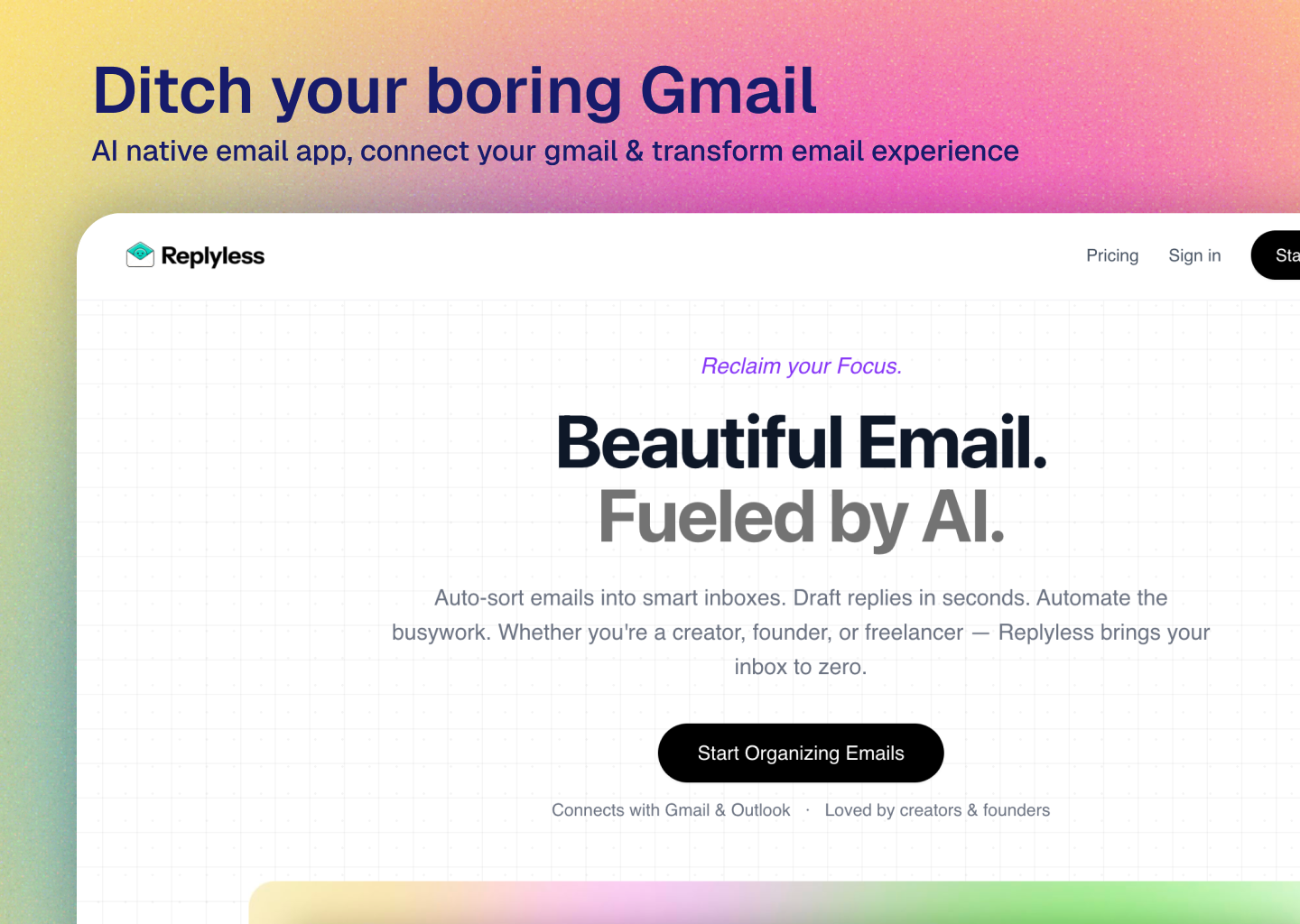
ReplylessAI’s core pitch is pretty legible. It’s an AI email app that sorts your inbox into categories, helps you reach inbox zero, and costs less than Superhuman. The positioning is explicit and a little aggressive. They name Superhuman directly in their own copy, which I respect as a product decision. If you’re going to be the affordable alternative, just say it.
The category-sorting feature is the one I’d want to put hands on first. Automatic email triage is a feature most modern email clients claim to do, but doing it well requires decent classification logic and, crucially, the ability to learn from corrections over time. The description doesn’t get specific about how the AI layer works under the hood, which is either a gap in the early marketing or a sign the product is still maturing.
The inbox zero framing is interesting because it’s a goal, not just a feature. Superhuman sells speed. Google’s built-in tabs sell passive organization. ReplylessAI is selling an outcome, which is a smarter way to talk to people who are already exhausted by email.
It launched and got solid traction on its first day, landing in the top ten on Product Hunt. 14 comments on launch day is a modest signal but suggests at least some people engaged meaningfully rather than just clicking upvote and moving on.
What I don’t know yet: what email clients it connects to, whether there’s a mobile experience, what the actual pricing tier looks like, and how the AI handles the stuff that’s genuinely hard, like identifying which “urgent” email from your boss is actually urgent. Those aren’t small questions. The difference between a good AI email client and an annoying one usually lives in exactly those edge cases.
The YC Application tag in their topics is worth a raised eyebrow. They’re either applying or they’ve been through it. Either way, it tells you something about how they see their own trajectory.
The Verdict
I think the positioning is smart and the timing is reasonable. Email AI tools are having a moment, and the premium-to-affordable wedge is a real strategy, not a fake one.
But the product page leaves too much unanswered for me to have strong conviction. No pricing listed, no screenshots in the research I could find, no founder context, no specifics on the AI layer. That could mean the product is early. It could also just mean the marketing hasn’t caught up.
What would make this work at 30 days: a clear pricing page, Gmail and Outlook support confirmed, and at least one visible testimonial from someone who actually moved from Superhuman. At 60 days: evidence the category sorting holds up outside of demo conditions. At 90 days: retention. Inbox zero tools have a well-documented problem where people try them for two weeks and drift back to whatever they were doing before.
I’d also want to know more about the founders. Execution in this category is everything. The AI productivity tools that have held my attention this year are the ones where you can feel a clear product thesis behind every decision. ReplylessAI has a thesis. I want to see the team that can carry it.