














shepherd-7676be00-4144-40e2-9ceb-1110b9e4c648
Focus & Productivity Time Tracker
A Sheep That Judges You for Being on Reddit: Shepherd Wants to Fix Your Browser Habits With a Mirror, Not a Lock
The Macro: The Attention Economy Has a Measurement Problem
Here is the uncomfortable truth about browser productivity tools: most of them are built around blocking things. You install them, whitelist your work sites, blacklist the fun ones, and then spend the next twenty minutes figuring out how to disable them because you actually needed to check Twitter for “research.” The category is crowded with tools that treat distraction like a security threat.
The Chrome extension market is genuinely large. According to Forbes, it reached $7.8 billion in 2024, growing 23% year-over-year. HTF Market Insights pegs the Chrome-specific slice at $2.5 billion, projected to double by 2033. Wherever the real number lands, the broader signal is clear: people are spending real money on browser software.
The productivity corner of that market has plenty of names in it. RescueTime has been tracking desktop habits for years and remains the category reference point. Toggl is the time-tracker that developers actually recommend to each other. Clockify showed up and made the free tier good enough to matter. Then there are the blockers, Cold Turkey, Freedom, and a dozen Chrome extensions that are essentially willpower-as-software.
What most of these tools share is an interventionist posture. They want to manage your behavior. The category assumption is that you cannot be trusted with accurate information alone, that knowledge of your habits won’t change them without enforcement.
Shepherd takes a different bet. It’s closer in spirit to the Tidy approach of surfacing data about your digital behavior and letting you draw your own conclusions, except Shepherd keeps it browser-native and, crucially, free. Whether passive visibility actually changes behavior at scale is the real product question here. The blocking crowd would say no. Shepherd’s team is betting the other way.
The Micro: A Chrome Extension That Grows a Sheep Based on Your Shame
Shepherd is a free Chrome extension. No account needed. The website says setup takes thirty seconds, and that sounds about right for something that runs silently in the background once installed.
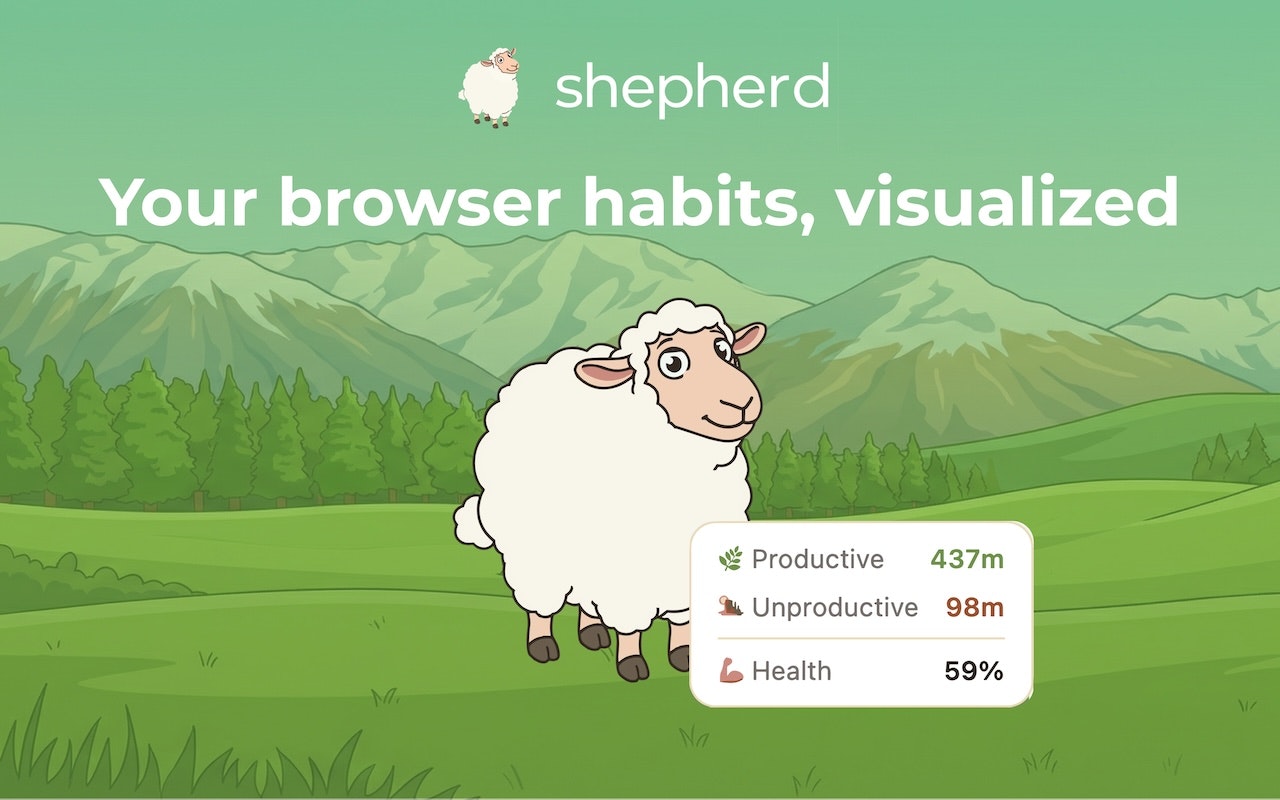
The mechanic is simple. Shepherd auto-tracks which sites you visit and for how long. You label sites as productive or not, either manually or by accepting the defaults. It then visualizes your focus over time and, in what is genuinely the most interesting product decision here, grows a sheep based on how you spend your browser hours. Spend most of your time working, the sheep presumably thrives. Spend it on YouTube autoplay and link aggregators, and I assume the sheep looks worse for wear.
The sheep is doing a lot of work in this product.
It’s the hook that separates Shepherd from just being another time tracker with a pie chart. The emotional feedback loop is the point. You’re not looking at a spreadsheet of minutes lost. You’re looking at a small animal whose condition reflects your choices. That is a different kind of nudge, and it’s a smart one, because it’s ambient rather than punitive.
Data stays local. No account, no sync, no server somewhere logging that you spent forty minutes on a sports scores site during your “deep work” block. That privacy stance is a meaningful differentiator against tools like RescueTime, which lives in the cloud by design. It also means Shepherd can’t sell your data, which is either a principled choice or a business constraint, probably both.
It got solid traction on launch day, which tracks for a product with a clear visual hook and a free price point.
The comparison that comes to mind is how Trupeer approached the screen recording problem: not by rebuilding the workflow from scratch, but by making the existing one smarter with minimal friction. Shepherd is the same instinct applied to browser tracking. The thirty-second setup is a feature, not a footnote.
What I’d want to know is how the labeling system works at edge cases. Is LinkedIn productive? Is Hacker News? The product lives and dies on how honest and granular that categorization can get.
The Verdict
Shepherd is a genuinely clean piece of product thinking. The core insight, that ambient feedback through something you’re mildly emotionally attached to might outperform hard blocks, is not obvious, and it’s worth taking seriously.
The free, no-account model is the right call for distribution. The privacy angle is real. And the sheep mechanic is the kind of specific, weird product decision that either becomes the thing people remember or the thing they find annoying after day three.
My honest read is that this works well for a specific user: someone who is already self-aware about distraction, who doesn’t need to be stopped so much as reminded. For that person, Shepherd is probably more pleasant and more sustainable than any blocker. For someone with a genuine focus disorder, a sad sheep is probably not the intervention they need.
At thirty days, I’d want to see whether people are still opening the extension or whether it became background noise. At sixty days, whether the labeling system has held up to real browsing complexity. The tab management problem is real enough that any tool with a durable retention number in this category earns attention.
The sheep is a good idea. Now it needs to stay interesting longer than a week.
Also featured on HUGE: Your Screen Recordings Are Rotting in a Folder Somewhere, Trupeer Wants to Fix That · TamLabs Thinks AI Can Redesign Knowledge Work and They’re Starting with Professional Services · Dex Wants to Be the AI Coworker That Actually Lives Where You Work