














base44-backend-platform
The Backend for the age of AI
Base44 Wants to Be the Backend You Never Have to Think About Again
The Macro: The Infrastructure Gap Nobody Wants to Talk About
The vibe-coding conversation has been almost entirely about the frontend. Claude writes your React components, Cursor autocompletes your hooks, and everyone posts demos of apps that look like they took twenty minutes. What those demos quietly skip is the part where you spend four hours configuring Supabase, debugging CORS errors, wiring up OAuth, and explaining to an AI agent why the API schema it invented on the fly doesn’t match the one from ten minutes ago.
That gap is real, and the money chasing it is real.
Software development tools sat at roughly $6.4 billion in 2025, projected to climb steeply through the decade. The broader software market lands somewhere between $730 billion and $824 billion depending on which analyst you trust, each number dressed up with whichever CAGR makes the slide look best. A meaningful chunk of that movement is pointed directly at the problem Base44 is trying to solve.
The competitors aren’t obscure. Supabase is the obvious one. Open-source, well-funded, beloved by the exact developer audience Base44 wants. Firebase still has enormous installed base inertia. PocketBase appeals to the self-host crowd. Convex has been quietly building a real case for real-time-first architecture. And Vercel keeps expanding its surface area in ways that give backend-as-a-service founders legitimate anxiety.
None of those tools were designed with AI agents as a first-class citizen. Base44 is betting that gap is a genuine opportunity rather than an existing product category with better marketing copy. That bet is at least worth examining seriously.
The Micro: One Command, Many Promises
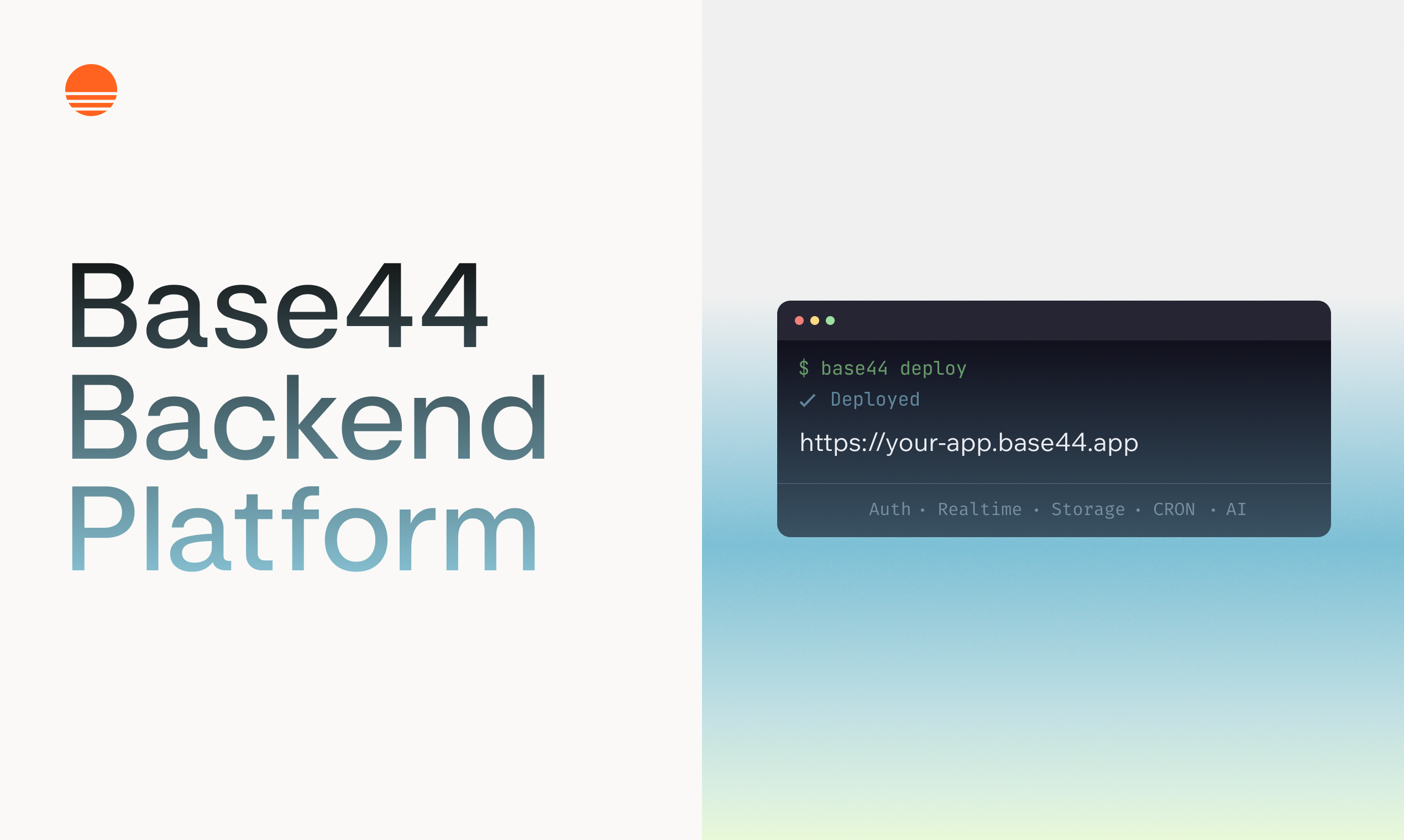
The pitch is operationally clean. You run npx base44 create my-app, an AI agent defines the backend schema based on your prompts, and you deploy with npx base44 deploy. That’s the surface loop. What’s underneath it is a more substantial feature set than the three-step diagram suggests.
Google OAuth ships out of the box, plus custom auth flow support. No Clerk subscription required. The database layer lets you define your data model in code with TypeScript support, and Base44 handles migrations, validation, and queries. Row-level security is built in rather than bolted on, which matters more than it sounds if you’ve ever tried to retrofit permissions onto a Firebase project in production. Realtime sync works without WebSocket configuration. File storage is CDN-backed. There’s a backend functions layer for sensitive server-side logic. The integrations list covers AI, email, files, and OAuth connectors for third-party APIs.
The most interesting product decision is what they’re calling Skills.
Instead of exposing a conventional REST or GraphQL API that an AI agent has to reverse-engineer or hallucinate its way through, Base44 wraps backend capabilities into pre-built Skills that Claude Code and Cursor can invoke directly. It’s a sensible call. AI agents are genuinely bad at API contracts they didn’t write. Giving them a simpler, opinionated interface cuts down on the back-and-forth token waste that makes agentic coding sessions feel like babysitting.
The website claims the platform has been “battle-tested by over 10 million apps.” That number appears only in their own marketing copy, so treat it accordingly. What is verifiable: the Product Hunt launch performed well, hitting the number one daily rank. That’s a legitimate launch. The founder, Maor Shlomo, previously co-founded Explorium and holds a Forbes 30 Under 30 mention. That signals operational credibility. It says nothing about whether this specific product ships well.
The Verdict
Base44 is solving a real problem in a way that’s smarter than just wrapping existing backend infrastructure in a CLI. The Skills abstraction is the most interesting bet on the table. If it works as described, it addresses something Supabase and Firebase structurally can’t fix without redesigning their interfaces from scratch. That’s not nothing.
The “10 million apps” claim needs substantiation. That’s the kind of number that either builds instant trust or quietly erodes it once people figure out it means something narrower than it sounds.
The competitive moat question is also real. Claude Code and Cursor could ship native backend integrations that make third-party platforms like this redundant. It’s happened before in adjacent categories, and it will happen again.
At 30 days, I’d want to know what developer retention looks like beyond the initial deploy. At 60 days, whether the Skills library is expanding or stalling. At 90 days, whether any meaningful production apps are actually running on it. Not demos. Not MVPs. Something with real traffic and real data requirements.
This isn’t overhyped. It’s correctly hyped for the moment. I think it’s probably a solid fit for solo builders and small teams who want a fast, opinionated backend without the configuration overhead, and genuinely less useful for teams with existing infrastructure preferences or serious compliance requirements. Whether the moment translates into something people actually depend on at scale is still an open question. Worth watching closely.
Also featured on HUGE: Cline Wants to Be the AI Agent That Actually Lives in Your Pipeline · Claude Code Has a Memory Problem. Claudebin Is at Least Trying to Fix It. · Superset Wants to Be the Air Traffic Controller for Your AI Coding Agents