
























zoer-ai-2
Build full-stack webapps from the database up
Zoer.ai Thinks the Vibe Coding Era Built Its Problem Into the Foundation
The Macro: Everyone Is Building From the Roof Down
The vibe coding wave produced a lot of things. Beautiful landing pages. Impressive demos. Startups that got to a prototype in forty minutes and then spent three months trying to figure out why their database schema looked like it was designed by someone who had never heard of a foreign key.
This is the actual problem nobody talks about enough. Tools like Lovable, Bolt.new, and Cursor are genuinely useful. I’ve watched people ship real things with them. But the dominant pattern in that space is UI-first generation: you describe a thing, it builds you a frontend, and the backend is something of an afterthought bolted on afterward. That works until it doesn’t, and for anything with real data complexity, it stops working pretty fast.
The broader productivity software market is enormous and growing by any measure you pick. Multiple sources peg it somewhere between $61 billion and $110 billion today, with projections running north of $190 billion by the early 2030s depending on who you ask. The “AI builder” slice of that is where the real fight is happening right now, and the fight has gotten crowded fast.
What’s interesting is that almost all the major players came at this from the same angle: make it easy to generate a UI, then figure out persistence and logic later. The assumption was that the hard part was the interface. A reasonable assumption, until you actually try to ship something commercial and realize the hard part was always the architecture underneath it.
Someone was going to come at this from the opposite direction eventually. That’s the opening Zoer.ai is trying to walk through.
The Micro: Schema First, Frontend Second, Actually Production-Ready Third
Zoer.ai comes from the team behind Chat2DB, a database tool that has already found a real user base. Jerry Fan, a co-founder of Chat2DB, is listed as connected to Zoer.ai on LinkedIn. That lineage matters, because it means the people building this are database people by disposition, not frontend people who decided to add a schema generator.
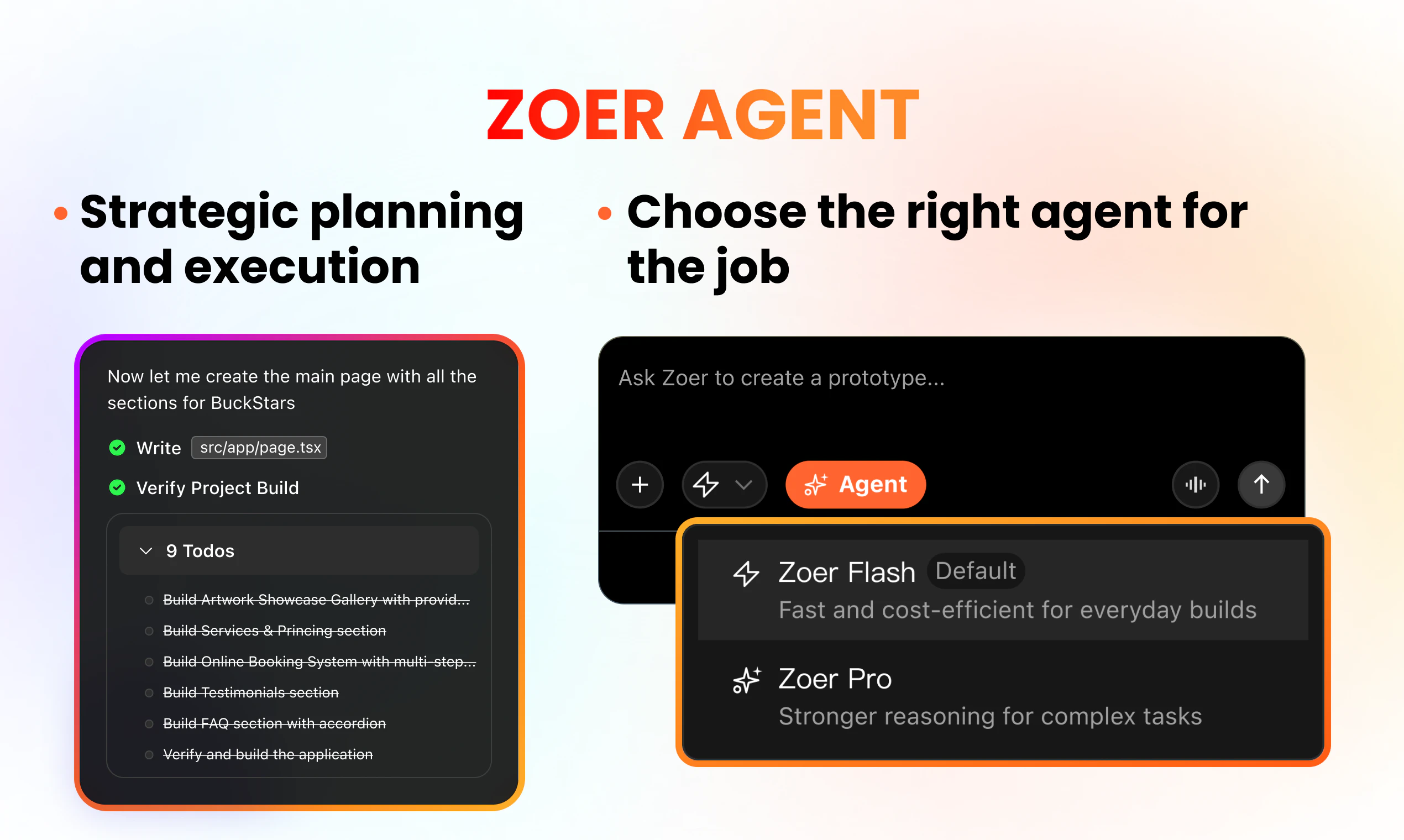
The core pitch is this: describe your application, and Zoer’s agent starts with the database. It designs the schema, builds the backend logic on top of that, and then generates the frontend last. The order is deliberate. The claim is that this produces apps that are actually ready for production load, with proper indexing and scaling considerations baked in rather than retrofitted.
It got solid traction on launch, sitting at number two for the day with meaningful comment volume, which at minimum suggests developers found the framing credible enough to engage with.
The positioning against tools like Lovable is explicit. Zoer’s own blog directly names Lovable, Bolt.new, and Cursor as alternatives, which is either confident or reckless depending on whether the product delivers. The SEO-friendly frontend claim is also in the pitch, which is a specific and testable detail I’d want to verify in practice.
What I find genuinely interesting here is not the AI generation part, which everyone has now, but the opinionated sequencing. Runner AI is making a related bet about owning the full stack, and there’s a real question forming in the builder space about whether the next layer of value is architectural opinion rather than just generation speed.
The website wasn’t scrapeable at time of writing, so I can’t speak to pricing, limits, or deployment model from firsthand inspection. That’s a gap worth closing before committing to anything.
The Verdict
Zoer.ai has a coherent thesis and a credible team to execute it. Those are two things that a surprising number of AI builder launches show up without.
The database-first framing is not just marketing positioning. If it actually works the way the pitch describes, it solves a real problem that most vibe coding tools have been quietly creating for a year. Developers who have tried to take a Lovable prototype to production know exactly what I mean.
What I’d want to know at thirty days: does the generated schema hold up under review from an actual backend engineer, or does it look reasonable and fall apart under scrutiny? At sixty days: are there production deployments running on it, and what does the failure mode look like when the architecture assumptions don’t fit someone’s use case? At ninety days: does the Chat2DB user base convert, and does Zoer find a paying customer profile that’s distinct from “developer who wanted to try the new thing”?
The genuine risk is that database-first generation is harder than UI-first generation, and the quality gap shows up at exactly the moment users trust it most. That would be a bad outcome for a product whose entire brand is reliability over flashiness.
I’m watching this one. The angle is right. Whether the execution matches it is the only question that actually matters.