






















spotify-songdna
The interactive creative network behind your favorite music
Spotify Finally Wants You to Know Who Made the Song
The Macro: The Music Industry Makes Money. The Creators Behind It, Not Always.
Global recorded music revenues hit $31.7 billion in 2025, up 6.4% year over year according to IFPI data. The streaming pie is genuinely growing. And yet if you asked most listeners to name the producer on their favorite song right now, they’d stare at you blankly. That’s not a bug in how people listen. It’s basically how the system was designed.
Physical liner notes at least tried. The CD era had a ritual to it: you’d open the jewel case, unfold the booklet, and somewhere in 6pt font was every session musician, every mixing engineer, every co-writer who touched the record. Streaming didn’t carry that forward. It just… didn’t bother.
There have been attempts. Musixmatch has been pushing for better credit infrastructure for years (their CEO Massimo Ciociola has been vocal about this, according to LinkedIn posts circulating around the SongDNA announcement). Genius built a whole content empire partly on the premise that context around songs is valuable. Apple Music has some credits functionality baked in, though it’s far from a clean experience. The data problem is real: music metadata is notoriously fragmented, inconsistently sourced, and sometimes just wrong.
Meanwhile, the creative side of music is having a moment culturally. Hyperpop made producers into stars. Producer tags (you know the ones) became memes. People actively want to know who made what. The audience is ready for this information in a way it maybe wasn’t ten years ago.
Spotify sitting on 700+ million users and finally deciding to actually show credits is either very late or exactly timed. Probably both.
The Micro: A Node Graph for Your Now Playing Screen
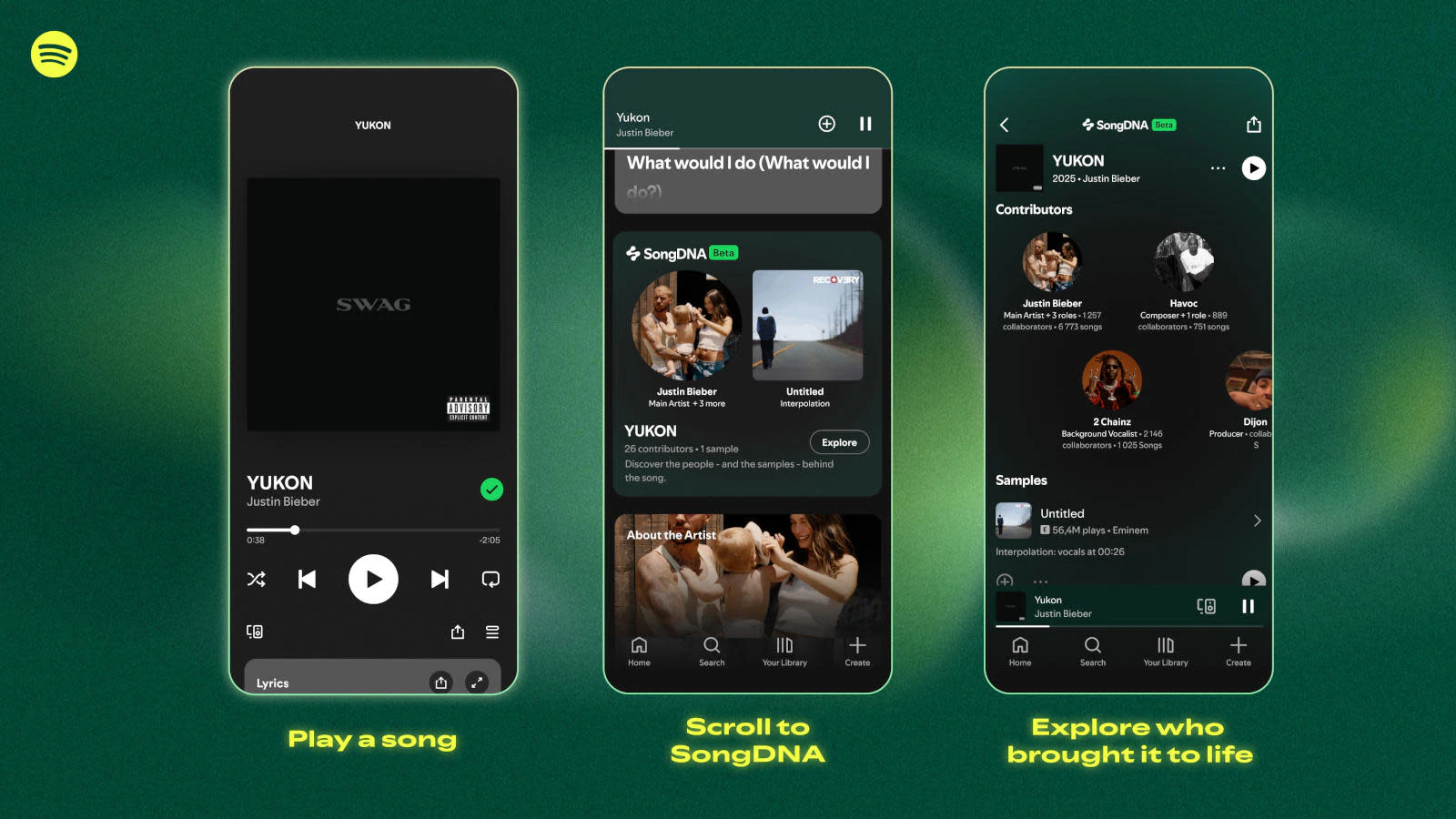
Here’s what SongDNA actually is. While a track is playing, you scroll down in the Now Playing view and find a SongDNA card. Tap it, and you get the full creative breakdown: songwriters, producers, collaborators, samples used, interpolations, and covers the song spawned. Then, and this is the part that makes it interesting, you can tap any of those people and explore their other work, then tap from there into their collaborators, and keep going.
It’s a graph traversal. If you’ve ever lost an hour on Wikipedia following links, the mechanic is structurally identical.
The data powering it is a mix of information submitted by artists and their teams, plus community-sourced contributions. That hybrid sourcing is the part I’d watch closely. Official data from labels and distributors tends to be reliable but slow to update. Community-sourced data moves faster but introduces accuracy risk. Spotify hasn’t spelled out exactly how they adjudicate conflicts between the two, which matters a lot if you’re a songwriter whose name is showing up wrong on someone else’s track.
It’s rolling out to Premium users globally, built into the mobile app. No new download, no separate product. Just a card that appears on supported tracks when you’re already listening. Low friction entry.
When it launched, it got solid traction, which makes sense. The feature taps directly into the “who produced this” curiosity that surfaces constantly in music communities online.
One product decision worth sitting with: this could have been its own tab or discovery surface, but Spotify kept it inside Now Playing. That’s a deliberate choice to make it contextual rather than destination-based. You find out who made the song you’re currently hearing, not who made songs in some abstract browsing session. I think that’s actually the right call. The moment of curiosity is while you’re listening, not twenty minutes later.
For producers and songwriters specifically, this is visibility they’ve basically never had inside a major streaming app before. Google’s been exploring AI-assisted music creation tools, but surfacing existing human credits is a different and arguably more immediate need.
The Verdict
I think this is genuinely good. Not in a breathless way. In the way where a platform with enormous reach finally does the obvious thing it should have done earlier and it turns out to still be worth doing.
The execution looks clean. The mechanic of following collaborator links is the kind of thing that should produce real discovery, not just trivia. And putting it in Now Playing instead of burying it in a menu suggests someone at Spotify thought carefully about when curiosity actually strikes.
What I’d want to watch at 30 days: does the data quality hold up across less mainstream catalogs? Big pop and hip-hop tracks will have solid metadata. An indie release from 2019 or a deep house record might not. If SongDNA cards are sparse or missing on anything outside major label releases, the feature starts feeling like a premium perk for already-famous songs.
At 60 days: do songwriters and producers actually see measurable profile growth from this? That’s the proof point for whether this becomes a tool the creative community actively supports or just tolerates.
At 90 days: is anyone using it to discover new music, or is it mostly a curiosity tap-once feature? The graph traversal mechanic has real potential. Whether listeners actually follow it more than one or two hops is a real question.
I hope it works. The credits problem in streaming has been embarrassing for a long time.