





















deep-personality
Science-backed personality insights for you and your partner
28 Assessments, One Hour, and the Audacious Claim That You'll Know Yourself Better Than Your Therapist Does
The Macro: The Personality Test Industrial Complex Finally Goes Consumer
The corporate personality assessment world has always had a quiet confidence problem. Tools like Hogan Assessments and the Predictive Index have spent decades selling deep personality profiling to HR departments at enterprise price points, built for hiring managers, not for the people actually being assessed. The person sitting across the table gets a label. The company gets a report.
That asymmetry is strange when you stop to think about it.
Consumers have been circling this space for years through a patchwork of free Myers-Briggs knockoffs, Reddit attachment style threads, and the occasional foray into actual therapy. The problem is that free tests tend to be shallow, therapy is expensive and slow, and the genuinely rigorous tools were never built for someone who just wants to understand why they keep picking the same kind of partner.
The broader education technology market is growing fast, forecast to expand by over $80 billion in North America alone according to Yahoo Finance, and self-directed learning products are a real slice of that. But the more honest frame for Deep Personality is the consumer mental wellness space, which has its own crowded field of apps promising clarity. What’s largely missing from that field is scientific rigor delivered without a clinical middleman.
Crystal Knows has tried to map personality from public data. Countless apps offer attachment style quizzes in five questions. Neither approach gives you the combination of breadth and depth that clinical-grade assessment tools actually provide.
The gap Deep Personality is targeting is real. Whether the product fills it the right way is the more interesting question.
The Micro: Twenty-Eight Assessments and an AI That Tells You What It Found
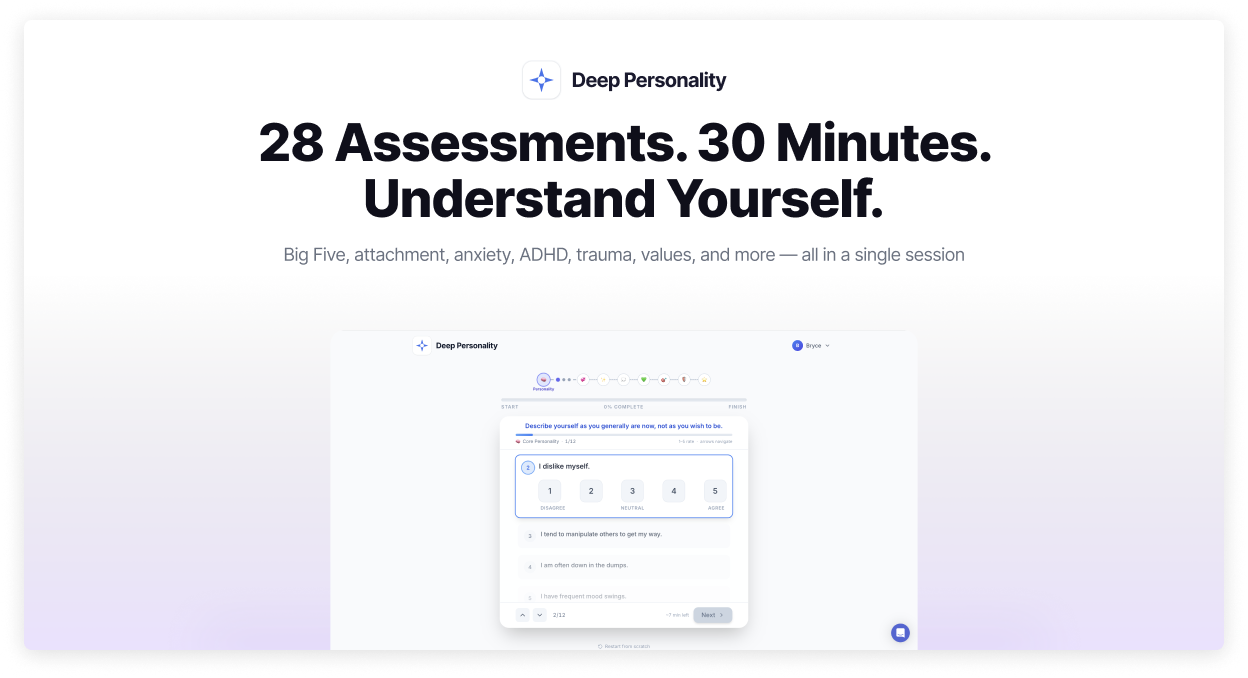
Here is what Deep Personality actually does. You sit down, spend under an hour working through 28 research-backed assessments covering personality traits, attachment style, mental health screening, neurodiversity indicators, and values. When you finish, you get scored results plus an AI-generated analysis of your patterns, blind spots, and strengths.
Then there is the comparison feature.
You can invite friends, colleagues, family members, or a romantic partner to complete the same battery, and the product generates an in-depth relational analysis. That is genuinely the most interesting product decision here. Most personality tools treat the individual as the endpoint. Deep Personality treats the relationship as the product.
The science question matters and I won’t pretend it doesn’t. Thirty-year-old clinical assessments with strong validity data are different from proprietary quizzes dressed up in research language. The product claims its 28 assessments are research-backed, but I couldn’t verify from the available information which specific instruments they use or how faithfully they’re implemented. A LinkedIn post from someone identified as an intern therapist named Jason Scriven suggested the tool was worth engaging with, and referenced a CEO named Lisa Burch in an approving context, but neither of those constitute independent clinical validation.
The EU situation is worth flagging plainly. The product is currently unavailable in the European Union due to GDPR compliance gaps. For a product handling mental health screening data, that is not a minor logistics issue. It tells you something about where the product is in its maturity.
It got solid traction on launch day, landing in the top three on Product Hunt, which suggests real consumer appetite.
The AI analysis layer is where I’d focus most of my skepticism and most of my curiosity. AI tools are increasingly being asked to do genuinely sensitive interpretive work, and the quality of that output depends entirely on what’s under the hood. A well-constructed prompt on validated data is different from a well-constructed prompt on shaky data.
The Verdict
I think this product has a legitimate idea at its center and a trust problem it hasn’t fully solved yet.
The insight that relationships are more interesting to analyze than individuals in isolation is a real product instinct. The comparison feature is the thing I’d actually want to use. Sitting down with a partner or a close friend and working through a shared analysis together sounds genuinely useful in a way that a solo personality quiz rarely is.
But the mental health screening piece requires a credibility foundation that the current version doesn’t fully establish from what I can see. Not because the team is necessarily doing it wrong, but because I can’t tell yet whether they’re doing it right. The GDPR gap suggests some foundational infrastructure is still being built.
At 30 days, I’d want to know what the completion rate looks like. An under-an-hour promise with 28 assessments sounds reasonable until you’re on number 19.
At 60 days, the question is whether the comparison feature drives referral loops or sits unused because getting a partner to complete the same battery is harder than it sounds.
At 90 days, the thing that will determine whether this is a real product or a very well-packaged quiz is whether anyone with clinical credibility endorses the methodology publicly. That’s the unlock. Without it, Deep Personality is interesting. With it, it becomes hard to ignore.