

producer-ai-by-google-labs
Turn ideas into tracks with your AI co-producer
Google Wants to Be Your Beat Maker. Sure, Why Not.
The Macro: The Music Industry Is Swimming in Money and Absolutely Terrified
Recorded music revenues hit $29.6 billion globally in 2024, according to IFPI. That’s a tenth consecutive year of growth. Goldman Sachs projects the number could nearly double by 2035. By most financial metrics, the music industry is doing great.
And yet everyone in it is visibly stressed.
The reason is pretty obvious if you’ve been paying attention. AI audio tools are arriving faster than the legal frameworks, the royalty structures, or honestly the creative consensus can keep up with. Suno, Udio, and a growing cluster of smaller players have spent the last two years training models on catalogued music and shipping products that let non-musicians make tracks that sound like something you’d actually hear somewhere. Major labels have sued. Artists have complained publicly. The discourse is extremely messy.
What’s interesting is that the tools bifurcate into two philosophies. There’s the “replace the musician” camp, where you type a prompt and get a finished song. And there’s the “assist the musician” camp, where the AI is positioned as a collaborator rather than the author. The second framing is more politically defensible, and it’s also where you see tools that working producers might actually touch.
Google entering this is not a surprise. They’ve had DeepMind audio research cooking for years, and products like MusicLM showed up in demos long before anything shipped publicly. What’s new is putting something under the Google Labs umbrella with a consumer-facing URL and a clear pitch: co-producer, not replacement.
The “co-producer” framing is doing a lot of work here. It’s a smart repositioning that sidesteps the “AI is stealing from artists” narrative, at least rhetorically. Whether the product actually delivers on that promise is a different question.
The Micro: What Producer AI Is Actually Selling You
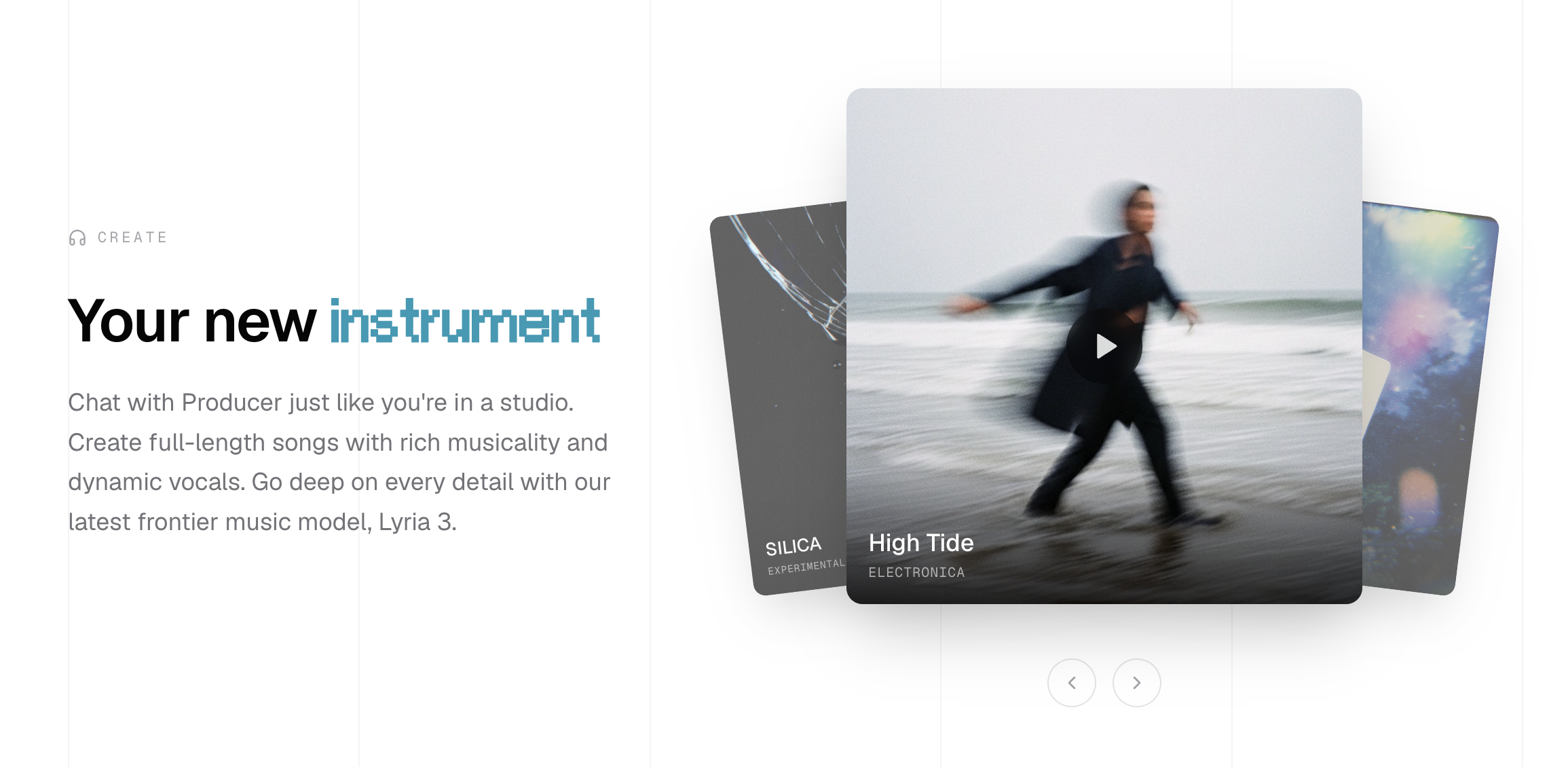
Producer AI lives at producer.ai, which is one of those domain names that costs more than most people’s cars, so someone made a commitment here. The pitch is a creative collaborator for lyrics, melody development, and genre experimentation, with the output being “dynamic tracks.” It’s now formally under Google Labs, which is Google’s public-facing experimental product arm.
The framing is deliberately broad. You’re not just generating audio, you’re supposedly developing something. Writing lyrics, shaping a melody, playing with genre. The co-producer metaphor implies back-and-forth, iteration, something more like a session than a prompt.
It did well on launch day when it hit Product Hunt, which tracks for a Google Labs drop.
Here’s what I find genuinely interesting about the product positioning: Google is not saying “make a song in 30 seconds.” That’s Suno’s lane. Producer AI is angling toward people who already have some creative intent, who maybe play an instrument or write songs but want a collaborator for the parts they’re stuck on. That’s a smaller addressable audience than “anyone who wants music,” but it might be a more defensible one.
The Google Labs wrapper also matters structurally. Labs projects get to exist in a beta-forever state without the pressure of a full product launch. They can iterate publicly. They can kill things quietly. It gives Producer AI runway that an independent startup wouldn’t have, but it also means this could disappear in eighteen months with a blog post and a polite goodbye.
I’d want to know how the actual generation pipeline works, whether it’s building on existing Google audio research or something new, and whether there’s any provenance layer for what it’s trained on. The scrape of the product site didn’t come through, so I’m working from the description and the Labs context. The specifics matter a lot here.
For comparison: Monologue for iOS and NVIDIA’s PersonaPlex work are both doing interesting things in the AI audio space with real technical differentiation. The difference is those products showed their work. Producer AI hasn’t yet, at least not publicly.
The Verdict
Google building an AI music tool makes complete sense. Google building it under Labs, with a co-producer frame instead of a generative-replacement frame, is actually a smarter move than I expected.
But I’m holding skepticism here.
The product site wasn’t scrapeable, the makers aren’t listed publicly, and the description is vague enough to mean almost anything. “Turn your imagination into dynamic tracks” is the kind of copy that sounds good until you try to figure out what you’re actually doing in the product. The co-producer metaphor is promising if it means genuine iterative creation. It’s hollow if it means “type a prompt, hear a song, feel good about it.”
At 30 days I’d want to see real user workflows posted online, not just the promo videos. At 60 days I’d want to know if working producers are touching it or if it’s only hobbyists. At 90 days the question is whether Google commits or quietly soft-archives it.
The honest answer is that Google has the audio research chops and the infrastructure to build something genuinely good here. Whether this specific product is that thing, I can’t tell yet. The tools that are actually changing how people build with voice AI tend to have a specific, defensible answer to “what can you do here that you can’t do anywhere else.” I haven’t seen Producer AI’s answer to that question. I want to.