













spawned
Build, launch, and discover products in a single platform
Spawned Wants to Be Product Hunt, Lovable, and Pump.fun at Once — Which, Look
The Macro: Everyone’s Building a Builder, and It’s Getting Crowded in Here
The problem with the AI-assisted development market in 2026 to $7.44 billion in 2026 according to Mordor Intelligence, with the broader custom software segment projecting even more aggressive expansion. Capital and attention are flooding in. Which means the undifferentiated prompt-to-app pitch is already table stakes.
The more interesting pressure is on the launch side.
Product Hunt has held its cultural position in the indie builder world through inertia as much as innovation. It’s still where you go to announce a thing, but it hasn’t fundamentally changed what it offers builders in years. Meanwhile, Solana token launchpads like Pump.fun normalized something genuinely different: early supporters having financial skin in the game before a product finds its feet. That’s a real model shift for early traction, not just a UI variation.
So the market Spawned is entering has two semi-distinct crowded lanes. AI builders on one side, discovery and launch platforms on the other, plus a third wilder lane involving crypto. Nobody has seriously tried to drive all three at once. That’s either because it’s a bad idea or because the right team hasn’t shown up yet. Anyone who tells you they know which one is guessing.
The Micro: One Prompt, One App, One Token (Optional, Thankfully)
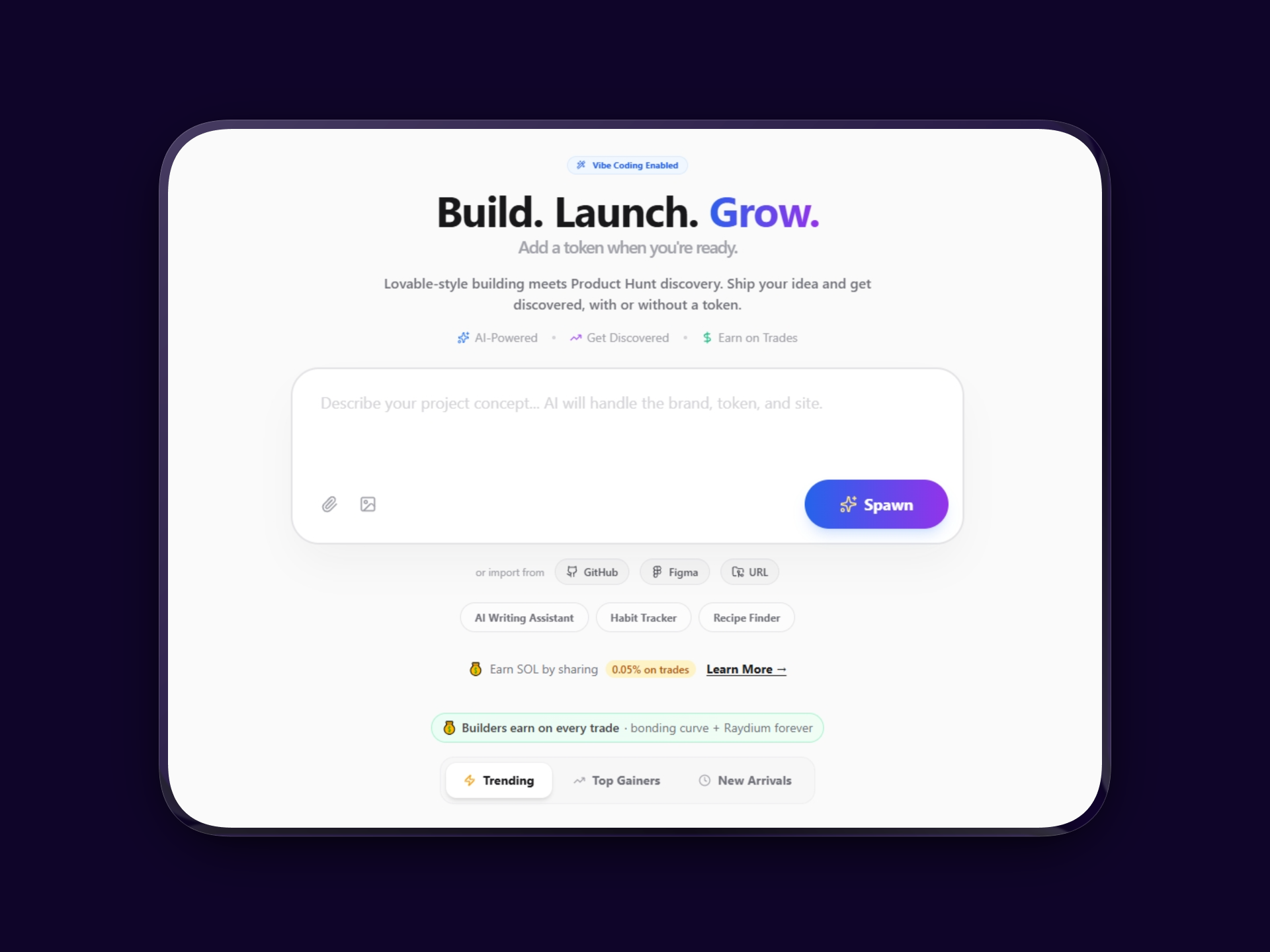
Spawned’s core loop is straightforward. Describe what you want to build, the AI ships a production-ready web app, you launch it to Spawned’s built-in discovery feed, and if you want, you attach a Solana token so early adopters can hold a stake in your thing. Import paths exist for GitHub, Figma, or a URL if you’re not starting from scratch. The platform supports landing pages, analytics dashboards, wallet connections, and more, all prompt-driven.
The discovery layer is the actual differentiator here.
Spawned runs upvotes, leaderboards, and a real-time trending feed baked directly into the same platform where you built the thing. The friction between “I built it” and “people can find it” collapses to nearly zero, at least in theory. The referral mechanic offering 500 bonus prompts per referred user signals that they’re thinking about growth loops seriously rather than betting on organic word of mouth alone.
The Solana token layer is the polarizing part. It’s optional, which is the right call. Making it mandatory would tank the addressable market immediately. But its presence signals clearly who Spawned is courting alongside the standard indie hacker crowd. Their own comparison pages pit them against Raydium for Solana launchpads, which is a specific and telling framing choice.
On launch day, it got solid traction on Product Hunt. The comment count was low for a product with this many moving parts, though. Interested enough to upvote, not curious enough to ask questions. That gap can mean the pitch is clear and self-explanatory. It can also mean people aren’t yet sure what to ask.
The website currently shows zero live projects in the discovery feed. That’s either a launch-day data artifact or a more uncomfortable signal about early adoption.
The Verdict
Spawned is doing something structurally interesting. I’ll give it that before I give it the rest. Collapsing the build-launch-grow sequence into one platform has real logic behind it. Builders lose momentum between tools. If Spawned can actually hold them end-to-end, that’s a retention argument its competitors don’t have.
The empty project feed is the number to watch, not the vote count.
A discovery platform with nothing to discover is just a builder with extra UI. The next 30 days are about whether real projects land on the platform and whether anyone comes back to find them. At 60 days, the question shifts to whether the token mechanic attracts a community or a crowd that evaporates when prices move. At 90 days, I’d want to know whether the AI builder output is actually production-quality or demo-quality. That distinction matters enormously once a real user touches it.
The founders, Anton Forsman and Ludvig Siljeholm according to LinkedIn, appear to be based in Sweden. That tells me roughly nothing useful about execution ability. What would move this from interesting thesis to real platform is a cohort of builders who launched here and got meaningful early traction they couldn’t have gotten elsewhere. That evidence doesn’t exist yet. Which is fine. It’s a launch. But it’s what I’m waiting for.
Also featured on HUGE: AI Code Review That Actually Read the Room (and Your Slack History) · Webflow Wants to Skip the Blank Canvas Problem — With a Prompt · PinMe Wants You to Deploy a Website Before You Even Remember to Make an Account