













ai-doc-writer-by-trupeer
Create finished, on-brand docs from simple recordings.
Your Screen Recordings Are Rotting in a Folder Somewhere — Trupeer Wants to Fix That
The Macro: Nobody Wants to Write the Docs, and the Market Knows It
Documentation is one of those things where everyone agrees it matters and almost nobody actually does it. Not because people are lazy. Because the tooling never fixed the underlying problem. Confluence and Notion are fine at storing docs. They’re useless at producing them.
The browser extension angle is interesting when you look at the numbers, though they vary enough between sources that I’d hold them loosely. The AI Chrome extension market was valued around $3.8 billion in 2024. Projections range from $21.6 billion by 2032 to a more conservative 13.1% CAGR through 2035, depending on which report you’re reading. Chrome holds roughly 64.86% global browser market share as of 2025. The distribution math is simple: if your tool lives in Chrome and Chrome is the default computing surface for knowledge workers, your addressable surface is enormous.
Competitors split into a few camps. Scribe and Guidde handle the screen-to-doc use case to some degree. Record a workflow, get a structured guide. Loom is adjacent but stays in video. Notion AI and Confluence’s AI layers help you write docs from scratch but don’t do anything with screen recordings. The gap Trupeer is targeting, taking an imperfect or informal recording and turning it into a finished, on-brand document, is real. It’s also underserved by the established players, who mostly assume you’re starting from a clean slate.
The “why now” is straightforward. Vision models have become capable enough to actually analyze screen content rather than just transcribe audio. That capability shift is recent, and it’s what makes the recording-to-doc pipeline plausible in a way it wasn’t two years ago.
The Micro: What It Actually Does When You Hit Record
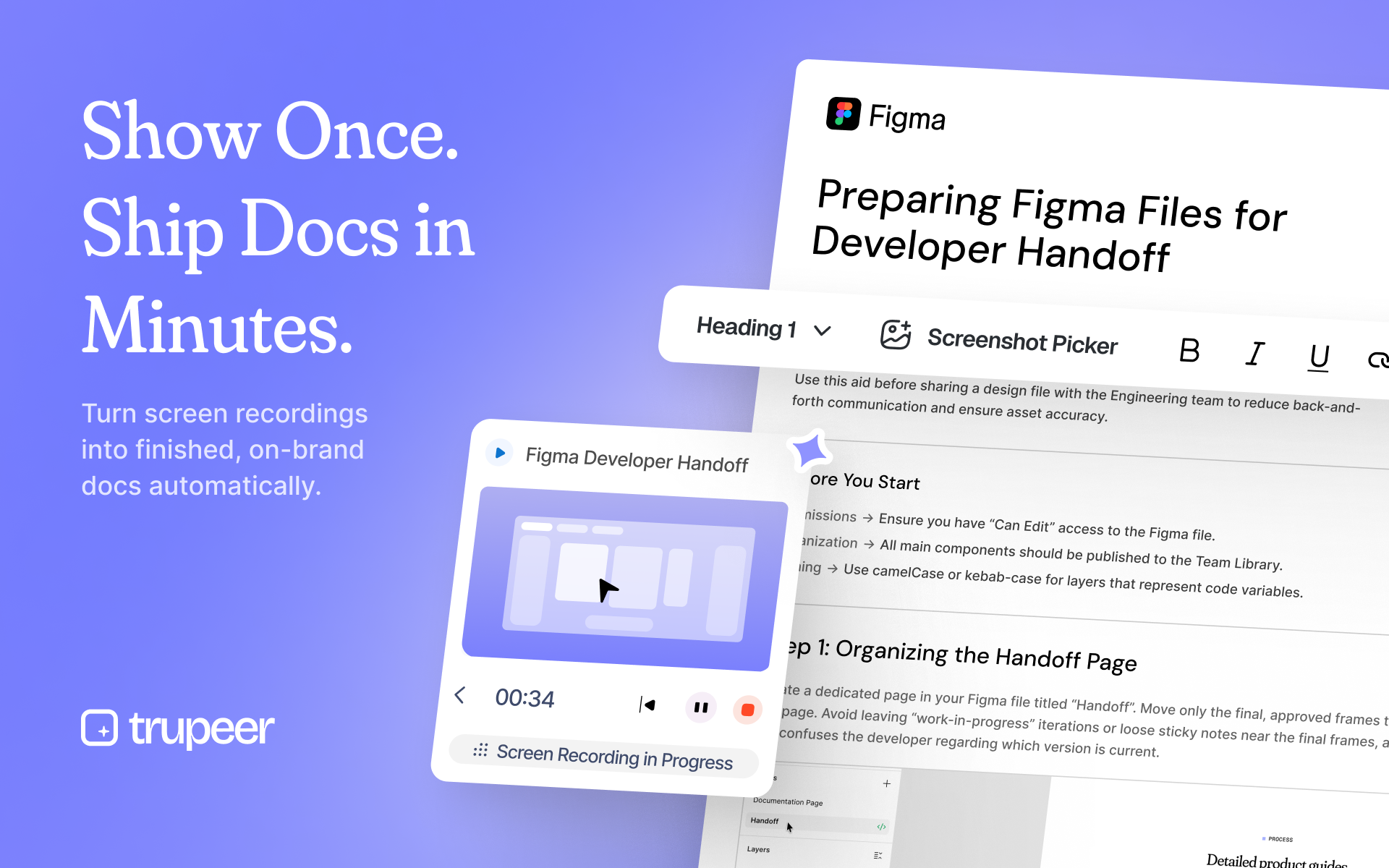
The core loop: you upload a recording, a screen walkthrough, a Zoom call, an internal demo, apparently even old or messy ones. Trupeer’s vision-based analysis reads what’s on screen, identifies the actions that actually matter, and produces a structured document with a summary, numbered steps, and relevant screenshots pulled from the recording and placed in context.
That last part is doing more work than it sounds like.
Anyone who has written process docs manually knows that the screenshot-capture-and-annotate step is where the time actually goes. Automating that step is not a minor convenience. It’s the part that makes the whole thing feel worth using.
The brand-matching feature is the other piece worth paying attention to. You upload a sample guide, your existing docs with your fonts, logos, tone, and structure. Trupeer learns from it and applies that template to everything it generates. Whether this holds up across wildly different document types is a real question. I’ll get to that in a moment.
The claim about vision-based analysis working on “imperfect or old recordings” is specific enough to take seriously. Most screen-capture tools assume a clean, linear walkthrough. Real internal recordings have false starts, tangents, and bad audio. If Trupeer handles that gracefully, that’s a meaningful technical differentiator, not a cosmetic one.
It got solid traction on launch day, with real comment volume that suggests actual product engagement rather than just polite upvote behavior.
It’s a Chrome extension, so onboarding friction is low. Record in the browser, get a doc. The demo content shows Figma handoff guides and CRM onboarding flows. Good choices for demonstrating variety without overcomplicating the pitch.
The Verdict
Trupeer is solving a problem that is genuinely painful and genuinely neglected. That’s a reasonable place to start.
The vision-based analysis angle is technically interesting and probably defensible in the short term. It’s not something you replicate by bolting a language model onto a screen recorder. There’s actual architecture required to make this work on messy, nonlinear input.
At 30 days, the question is whether the people who showed up on launch day actually use the product. Product Hunt launches convert initial curiosity into real usage at wildly variable rates. The brand-matching feature needs to hold up against actual enterprise style guides. The demo examples are clean. Real company docs are not.
At 60 to 90 days, the question becomes whether teams adopt this as infrastructure or use it once and move on. Documentation tools live and die on habitual use. Scribe survived by embedding itself into customer success and operations workflows. Trupeer needs a similar wedge, probably starting with technical writers and customer success teams who produce high volumes of how-to content.
Here’s where I’d actually land on this. I think this is probably a strong fit for ops teams, customer success, and technical writers who are drowning in documentation debt and don’t have time to do it the manual way. I don’t think it’s going to work for teams that need highly precise, regulated, or heavily structured documentation output without significant human review on the back end.
Two things are load-bearing before I’d fully endorse it: the accuracy rate on genuinely messy recordings with real imperfect input, and whether the brand-matching holds up on anything more complex than the demo examples. If both of those work at the level the product implies, this is genuinely interesting. If either is soft, it’s a polished demo wrapped around a commodity workflow.
Also featured on HUGE: Praxim Wants to Fix Document Editing, Not Just Autocomplete It · Verbiflow Built a Sales Pipeline That Runs Itself, and I Almost Believe Them · Maige Thinks Your Issue Tracker Is Broken and AI Should Run It