














The Macro: Everyone Hates Forms, Nobody Has Fixed Them
The form-builder market has been “innovating” for about fifteen years. The dominant experience is still a vertical stack of labeled boxes that feels like filing your taxes.
Typeform made conversational forms a real product category, probably a decade ago now. The lesson the industry took from that was to add more question types rather than rethink the interaction model. So here we are.
The AI wave was always going to hit this space. Now it has, all at once, and Formaly is competing against GPTForm.ai (listed explicitly as an alternative on SourceForge), whatever Typeform’s AI features have quietly become, and approximately eleven other tools that launched this quarter with some version of “chat interface meets survey.” The crowding is real. Worth saying upfront.
What makes the timing interesting isn’t some abstract AI readiness argument. It’s that the completion rate problem is genuinely bad. Formaly’s own marketing cites a 30% industry average completion rate for traditional forms. That number is directionally accurate even if the precise figure is theirs to defend. If you’ve ever tried to collect post-purchase feedback at scale, you know most people abandon before question three. A chat interface that mimics something respondents already do all day on their phones is a reasonable hypothesis for fixing that.
The A2P messaging market context that surfaces in the research, $71.7 billion globally in 2024, is only loosely relevant here. Formaly isn’t a messaging infrastructure play. But the underlying signal matters: people are extremely comfortable receiving and responding to conversational messages in business contexts. That behavioral norm is what Formaly is trying to borrow.
The Micro: Prompt In, Form Out, Insights Allegedly Included
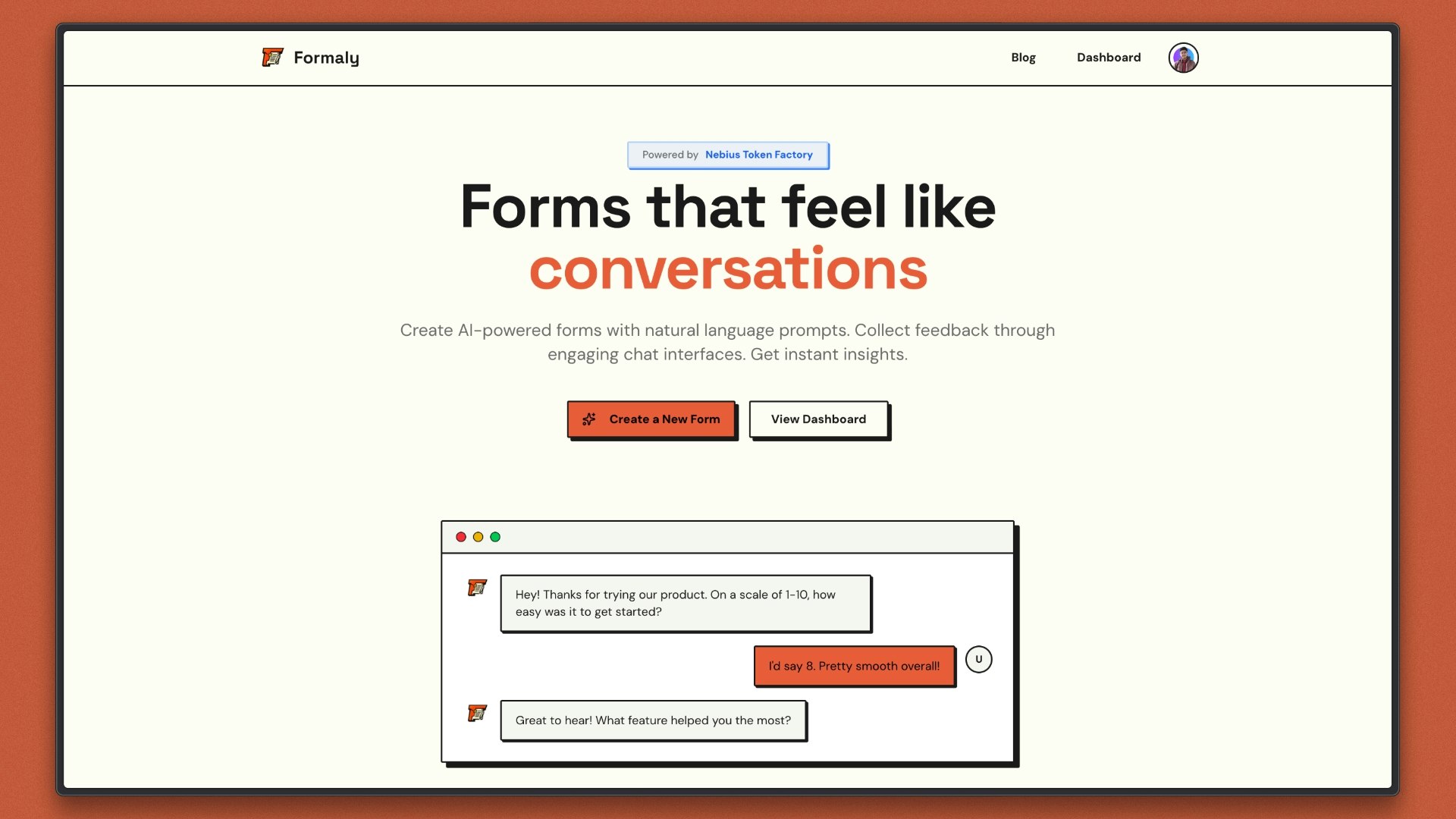
The core loop is genuinely simple. You describe what you want to learn in natural language, Formaly generates a conversational form, respondents answer through a chat interface, and AI processes the responses into themes, sentiment, and notable quotes. Four steps.
The website demo shows the kind of back-and-forth you’d expect. The form asks a question, the user types a response, the form follows up naturally. It reads less like a survey and more like a product manager badgering you in Slack, which is either more or less annoying depending on your relationship with your product manager.
The AI generation piece is powered by Nebius Token Factory, credited explicitly on the site. That’s a notable infrastructure choice. Nebius is the AI cloud spun out of Yandex’s international operations, and choosing it suggests the team made a deliberate decision about cost structure and model access rather than just defaulting to the OpenAI API like everyone else. Small detail. Tells you something.
Formaly lists support for feedback forms, quizzes, and surveys, plus flexible question types. That covers the main use cases without overreaching into territory they’d need to defend. The mobile experience gets called out specifically on the site, which matters. Completion rates on mobile static forms are measurably worse than desktop, so if the chat interface genuinely closes that gap, that’s a real product advantage rather than a vibe.
It got solid traction on launch day on Product Hunt. Forty-eight comments is a decent engagement ratio for that vote count. People apparently had things to say, which usually means the product is either confusing or interesting.
The site claims 75%+ completion rates versus the 30% industry average. That’s a big claim with no source attached. I’d want to know what sample size that’s sitting on before repeating it to anyone who matters.
The Verdict
Formaly is a competent entry into a legitimately crowded space. I mean that more kindly than it sounds.
The conversational form category is real. The completion rate problem is real. An AI that generates the form from a prompt instead of making you drag-and-drop for twenty minutes is a genuine quality-of-life improvement. The Nebius infrastructure choice suggests more technical intentionality than your average weekend-project launch.
At 30 days, I’d want to know what retention looks like for teams who built a form and got responses. The creation experience is the easy part to demo. The hard part is whether the AI insights layer is genuinely useful or just a sentiment-colored word cloud with extra steps.
At 60 days: whether anyone is paying, and what conversion from free to paid looks like. The website shows a free tier prominently and nothing else. That’s a launch-day choice, not a business model.
At 90 days: how they’re differentiating from GPTForm.ai and the inevitable Typeform AI push in a way that isn’t just price.
I think this works well for small teams who need a fast, low-friction way to collect qualitative feedback and don’t have time to build something polished in Typeform. I think it struggles the moment a larger organization asks hard questions about data handling, custom branding, or integration depth. The product is real. The market is genuinely competitive. Root for them, but ask for the completion rate methodology.
Also featured on HUGE: Your AI Agent Has a Brain. ClawdTalk Wants to Give It a Phone Number. · Costream Wants to Index Every Conversation Happening Inside Your Product