














predictleads-technographics-dataset
Source-backed technographics with an API and MCP server.
The Tech Stack Is the Tell: PredictLeads Wants to Make Technographics Actually Useful
The Macro: Selling to Companies Based on What They Actually Run
Technographics, the practice of cataloguing what technologies a business uses, has been a B2B sales and marketing staple for over a decade. The logic is simple. If you sell a Salesforce integration, you want to find companies running Salesforce. If you’re pitching a data warehouse migration, knowing your prospect is still on legacy infrastructure is worth real money.
The problem has always been data quality.
The main players in this space, BuiltWith, HG Insights, and Similarweb’s technographic layers among others, have taken sustained criticism for stale detections, opaque methodology, and coverage gaps on smaller or less web-visible companies. BuiltWith, the oldest name in the category, built its product largely on browser-side technology fingerprinting. Scan the page, see what JavaScript loads, call it done. That works reasonably well for front-end tooling. It falls apart for anything behind a firewall, buried in a job description, or visible only in DNS records.
The market context matters here. B2B data has gotten more crowded and more scrutinized. Buyers, who are increasingly technical themselves, want provenance. Not just that a company uses Snowflake, but when that detection was first observed, when it was last confirmed, and what signal produced it. That demand for explainability has arrived roughly in parallel with AI-assisted prospecting workflows, where bad input data doesn’t just produce a missed deal. It produces a confidently wrong AI agent doing something embarrassing at scale.
There’s also a timing argument for an API-first, MCP-compatible technographics product. As more sales and marketing tooling gets rebuilt around language model agents, the data layer needs to be programmable in ways a CSV export or a BuiltWith Chrome extension simply isn’t.
The Micro: 46,000 Technologies, Timestamped and Cited
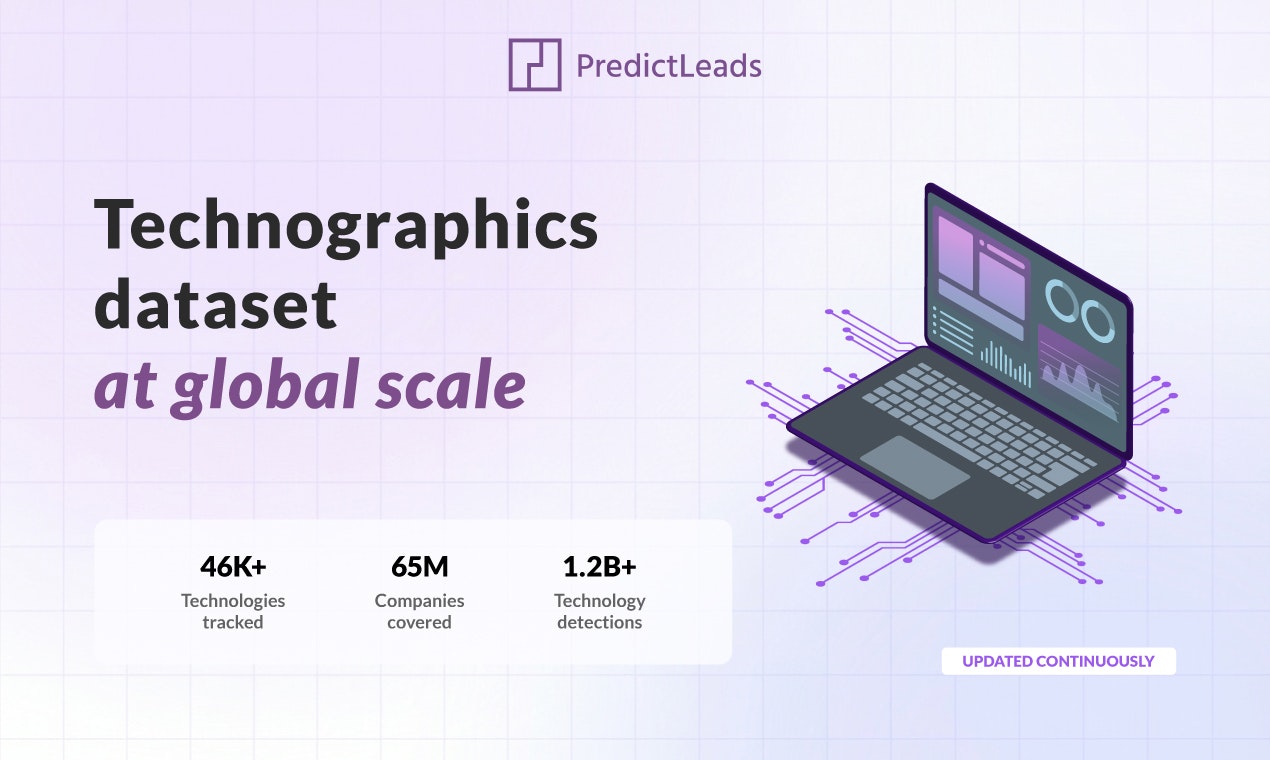
PredictLeads Technographics Dataset tracks over 46,000 technologies across what the company claims is 65 million companies. That’s a big number, comparable to BuiltWith’s public coverage figures, but the more interesting claim isn’t coverage breadth. It’s methodology depth.
Each detection comes with a first-seen and last-seen timestamp, a confidence score, and explicit citations pointing to which subpages triggered the detection, which DNS records, which job postings. The sample API response on their site shows exactly this structure: a technology_detection object with first_seen_at, last_seen_at, a numeric score, and nested relationships to specific DNS records and subpages. That’s not how most technographics data gets served. Most of it arrives as a flat list with no audit trail at all.
The sourcing methodology spans company websites, job descriptions, DNS records, and cookies. Job description parsing is the most interesting piece. A company posting Databricks roles consistently for six months is almost certainly either running Databricks or actively migrating to it. That’s a qualitatively different signal than a JavaScript tag spotted on their homepage.
Delivery is via REST API, flat file downloads, webhooks, and an MCP server. That last one likely drove the launch timing. MCP, Anthropic’s open standard for connecting AI agents to external data sources, means an agent can query company tech stacks directly without a human in the loop. That’s a real workflow unlock for anyone building AI-assisted prospecting or competitive intelligence pipelines.
The launch got solid traction on launch day, which is notable for a data API product whose buyers aren’t typically spending their afternoons browsing there. The comments skew predictably toward pricing and coverage questions rather than philosophical enthusiasm.
The Verdict
PredictLeads is making a specific and defensible bet: the next wave of technographics buyers are developers and AI engineers who need structured, source-cited, programmatically queryable data, not marketers who want a browser plugin.
The MCP server is the sharpest signal of what they’re building toward.
If agentic sales workflows become as common as people currently expect, dropping a technographics lookup into an AI pipeline without writing a custom integration is genuinely useful. Most competitors haven’t shipped that. What would make this work at 90 days is meaningful developer adoption, credible examples of the timestamp and confidence-score data catching something competitors missed, and a pricing model that doesn’t require an enterprise procurement process just to evaluate.
What would make it stall: the 65 million company figure masking thin coverage on the long tail of smaller companies where the interesting signal actually lives, or confidence scores that are noisy enough to add doubt rather than reduce it.
I think this is probably a solid buy for technical sales teams building agentic prospecting pipelines, and a much harder sell to traditional demand gen buyers who don’t yet care about provenance. Source transparency should be a compelling differentiator, especially as AI agents act on this data autonomously. Whether enough buyers currently value it to switch is a real open question. That’s the one I’d want answered before calling it.
Also featured on HUGE: Cube Wants to Be the Semantic Layer AI Actually Uses — Not Just the One You Deploy and Forget · One API to Rule Them All — And a Money-Back Clause If It Doesn’t · One API to Rule Your Claws: Chowder Bets the AI Agent Deployment Problem Is Bigger Than It Looks