














chowder-dev
Single API for launching OpenClaw instances.
One API to Rule Your Claws: Chowder Bets the AI Agent Deployment Problem Is Bigger Than It Looks
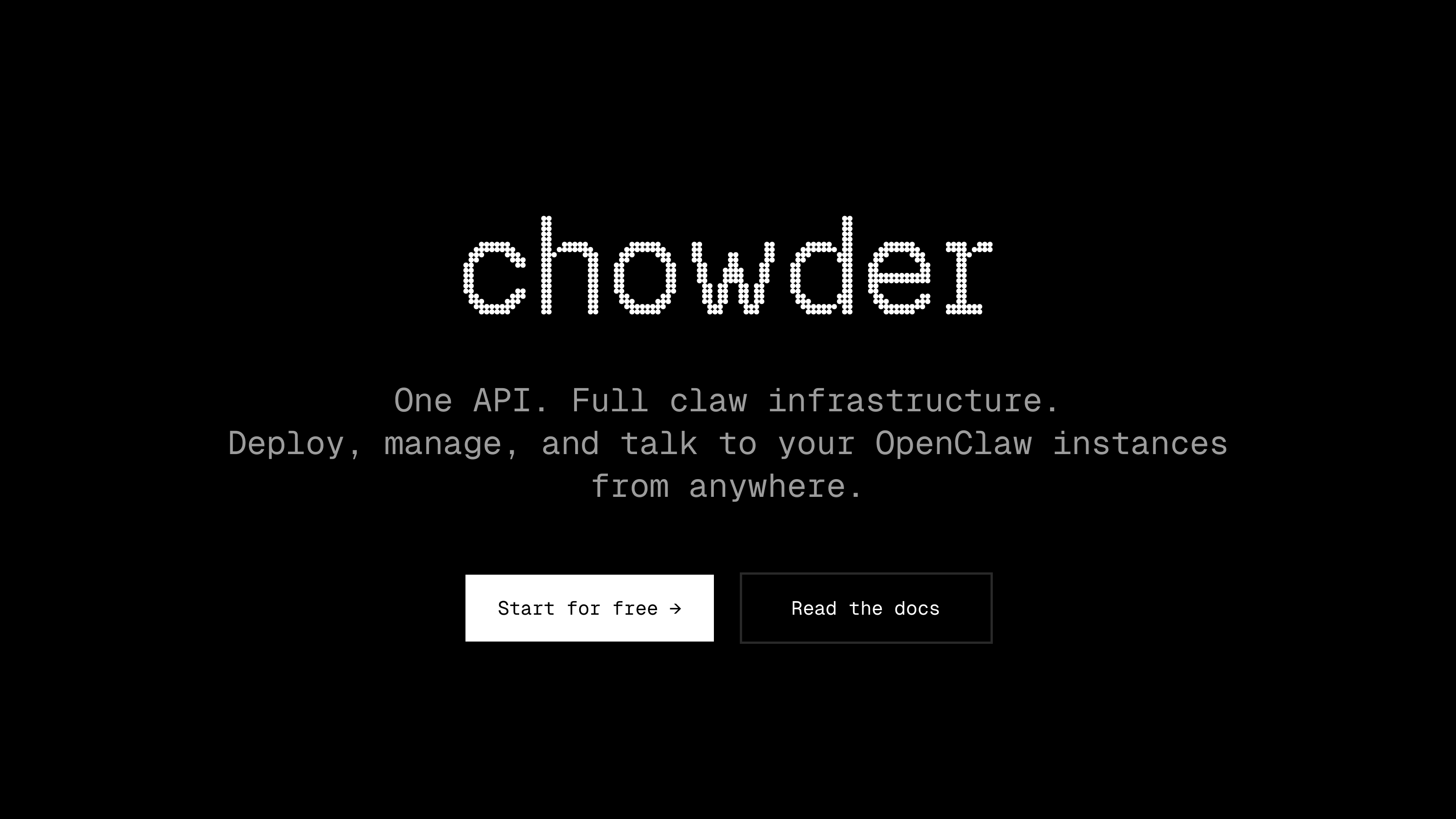
The Macro: The Deployment Gap Nobody Talks About
Building a functional AI agent has never been cheaper or faster. The hard part has quietly shifted downstream. Infrastructure, distribution, operations. Getting your agent talking to users on Slack, persisting memory across sessions, handling auth without a security incident, scaling without babysitting a server cluster. That’s the unsexy work that eats engineering weeks.
The market backdrop is genuinely large. The API management and developer tools space has attracted serious investment precisely because every serious software team now has at least one AI-adjacent project in flight and needs the plumbing to match. The OpenAI Responses API format has become a de facto standard. Not because it’s perfect, but because enough tooling has been built around it that deviating carries real cost. That compatibility surface is now a competitive moat worth borrowing.
The specific niche chowder.dev is targeting sits at an intersection that didn’t meaningfully exist two years ago. Managed deployment infrastructure for OpenClaw instances. OpenClaw itself is a relatively new entrant in the agentic framework space, which means the surrounding tooling is thin. That’s either an opportunity or a warning sign, depending on how much adoption OpenClaw actually has.
For now, call it a calculated bet.
Direct competitors are hard to pin down precisely because chowder.dev is combining several distinct capabilities into a single API surface. Managed compute, channel integrations, a skills marketplace, auth management. Pieces of this exist elsewhere: agent hosting platforms, integration middleware, auth-as-a-service tools. Nobody has cleanly bundled them around OpenClaw specifically. Whether that’s because the demand is real and the gap is genuine, or because the demand isn’t large enough to bother, is the central question hanging over this launch.
The Micro: What Chowder Actually Does (And Why the API Design Matters)
Chowder is, in the most precise terms, a managed infrastructure layer for OpenClaw agents. You call their API, you get a running, isolated agent instance with its own sandbox and workspace. From there, you can connect it to eleven messaging channels, including Telegram, Discord, Slack, WhatsApp, and Signal, without writing any integration code yourself. You install capabilities from ClawHub, their skills marketplace, via API call. Auth is handled through organization-level keys, scoped instance keys with granular permissions, and automatic rotation. Sessions and memory are stateful out of the box.
The technical decision worth taking seriously is the OpenAI-compatible interface.
Chowder uses the OpenAI Responses API format as its communication standard. Same input/output shape, same session and tool conventions. Developers who already know that format can drop Chowder in without relearning an API contract. It’s a sensible move. Reduce adoption friction by speaking the language developers are already using, even if the underlying agent is an OpenClaw instance rather than a GPT-4o.
The onboarding sequence from their docs makes a specific claim: signup, create instance, call the chat endpoint, allegedly under sixty seconds. That’s either true and valuable, or it isn’t. Beta periods exist to find out. It got solid traction on launch day, which suggests the people who’d actually use this recognized what they were looking at.
The founders have YC W24 background through Brainbase, which means they’ve been in the agentic infrastructure space for at least a cycle. The product is currently in beta, with a free tier to start.
The Verdict
Chowder is solving a real problem. Agent deployment is legitimately tedious and the tooling is immature. But it’s solving that problem for a specific framework that hasn’t yet demonstrated the kind of gravity that makes infrastructure bets feel safe.
That’s the load-bearing uncertainty here.
If OpenClaw adoption accelerates, chowder.dev is extremely well-positioned. First-mover on managed infrastructure, with the right API compatibility decisions already baked in. If OpenClaw stays niche, chowder.dev is a well-built product waiting for a market that’s slow to arrive. I think it’s a strong fit for developers already bought into the OpenClaw approach, and a hard sell to everyone else until the framework itself proves out.
At thirty days, the question is whether developers are actually completing that sixty-second deploy flow or dropping off somewhere in the auth setup. At sixty days, it’s whether any of the eleven channel integrations are seeing real usage. “Supported” and “used” tend to be different numbers. At ninety days, it’s whether the skills marketplace has enough third-party contributions to function as intended or is still mostly a feature list.
What I’d want to know before fully endorsing it: OpenClaw’s actual developer adoption numbers, and whether chowder.dev has any signal on retention beyond the initial deploy. A product that gets you to a running agent in sixty seconds is satisfying. A product that keeps that agent running reliably for sixty days is a business.
Also featured on HUGE: One API to Rule Them All — And a Money-Back Clause If It Doesn’t · Anything API Wants to Give Every Website an API Whether They Like It or Not · ReJot Thinks APIs Are Broken, and Their Fix Is Surprisingly Elegant