





























cushion-8
combines posts, messaging, + check‑ins for better teamwork
Cushion Thinks Your Team Chat App Is the Problem. They Might Be Right.
The Macro: Slack Ate Your Brain and Charged You for the Privilege
Here’s the thing about the team messaging market. It’s enormous, it’s entrenched, and it’s also kind of a disaster for the people actually using it. Slack is on track to hit over $4 billion in revenue by 2025, according to multiple sources, and reportedly has around 42 million daily active users. That’s not a product people are abandoning. That’s a habit so deep it’s basically infrastructure.
And yet. Talk to anyone on a distributed team and they’ll tell you the same thing. Important decisions get buried in a thread that scrolled off the screen two weeks ago. Someone asks a question that was already answered. Knowledge evaporates. The product that was supposed to make your team faster somehow made everyone feel like they were always behind.
That’s the actual opening Cushion is betting on. Not that Slack is losing. That Slack is winning in a way that left real problems unsolved.
Which, look, this isn’t a new observation. Linear came for Jira. Notion came for Confluence. Every few years someone correctly identifies that the dominant tool has tradeoffs the market is willing to accept, and then builds something tighter for the people who can’t accept them anymore. Most of those challengers find a small, loyal audience and stop there. A few of them matter.
The async communication angle is particularly interesting right now. Remote teams aren’t going away, the nine-hour average daily Slack login time is both impressive and horrifying, and the backlash to real-time everything is real and growing. There’s a genuine wedge here for a product that treats focused communication as a feature, not an afterthought.
Whether Cushion is that product is a different question.
The Micro: Posts Over Pings, Agents Over Admins
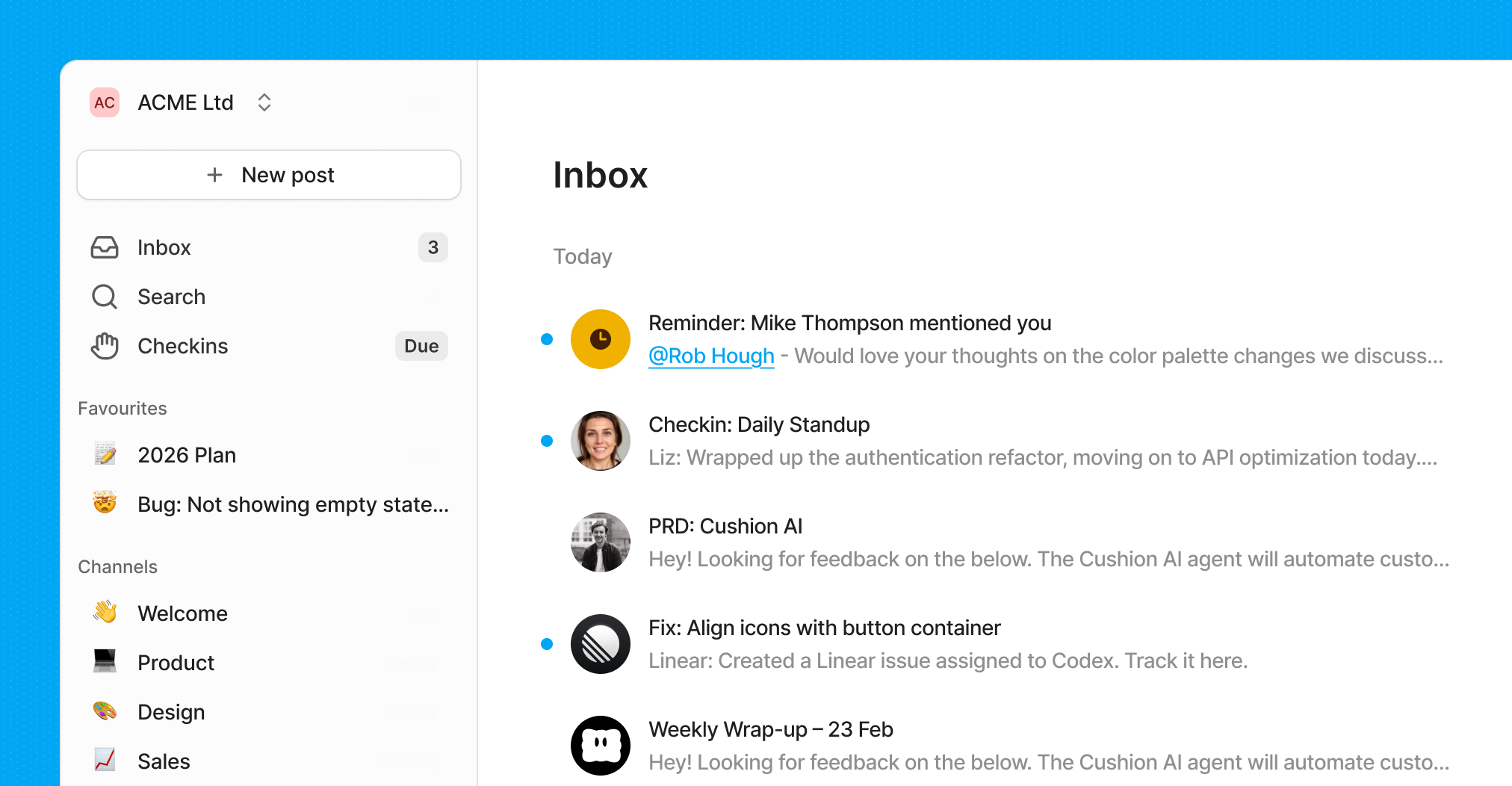
Cushion’s core bet is structural. Instead of a stream of messages, the primary unit of communication is a post. Single topic. One thread. Everything related to that conversation lives together on one page, and it doesn’t drift into twelve different rabbit holes because someone started typing in the wrong channel.
That’s a real design decision and I respect it. The chaotic inbox problem on Slack isn’t just cultural, it’s architectural. Cushion is saying the architecture has to change first.
The product also layers in check-ins, which look like lightweight standups built directly into the app. Daily standup, weekly goals, that kind of thing. So instead of your async rituals living in a Google Form or a bot you’ve half-configured, they’re a native feature. That’s smart. It reduces the coordination overhead that makes remote teams add five more tools to solve problems that should be solved by one.
Direct messages are still there. Channels are still there. So it’s not a radical departure from the mental model most teams already have. It’s more like a reconfigured version of it, with the post as the thing that’s supposed to carry the weight instead of the chat thread.
The AI piece is interesting and a little half-shown. The website mentions resolving conversations with AI and a set of agents that can handle repetitive tasks. The demo copy shows an AI summary of a user feedback session. That’s a useful thing, actually. Meeting summaries and thread resolutions are exactly the kind of busywork that eats time and doesn’t require judgment. I’d want to see more of how the agents work in practice before I got excited about that specifically.
It got solid traction when it launched, which suggests the pitch is landing with people who already feel the pain.
The interface looks clean. The channels and DMs feel familiar enough that onboarding a small team wouldn’t require a week of convincing. For teams using something like CoChat’s approach to shared AI tooling or running Viktor as a lightweight team layer, Cushion could actually slot in without too much friction.
The Verdict
I think Cushion is solving a real problem with a coherent point of view. That’s more than I can say for a lot of what I look at.
But here’s the thing. The graveyard of Slack alternatives is enormous. The challenge isn’t building something better, it’s getting a team to migrate. That switching cost is brutal, and Cushion is specifically targeting small distributed teams, which means they’re probably targeting teams that already have a Slack habit and a limited IT budget. That’s a hard sale.
What would make this work at 30 days is finding a specific team type, maybe early-stage startups or agencies, where the async post model matches how they already think. At 60 days I’d want to know if teams are actually defaulting to posts or reverting to DMs the second something feels urgent. At 90 days I’d want to see retention numbers from teams that made the switch.
The AI agent layer could be the differentiator if it actually works well. Right now it reads like a feature in progress. I’d also want to know how search holds up over time, because the whole premise breaks down if old posts become unfindable.
Overhyped? Not yet. Under-pressure-tested? Definitely. I’m watching this one.