


sellshots-2
High-converting AI product photos in seconds
You Don't Need a Studio. You Might Not Need a Photographer Either.
The Macro: Everyone Selling Online Has the Same Problem
Here’s the thing about selling on Amazon or Etsy or Shopify: the product is almost never the hard part. The photo is.
Shooting product photography properly costs money most small sellers don’t have. A real studio day, a model, a retoucher, maybe a creative director if you’re being fancy. That pipeline exists for brands with budgets. It has never really existed for the person selling handmade candles out of their apartment or the bootstrapped DTC founder trying to move inventory without burning cash on a shoot that may or may not convert.
AI stepped into that gap fast. Maybe too fast. PhotoRoom has been doing background removal and basic scene generation for a while now. Claid.ai is positioned more toward volume and API use. Pebblely, Caspa, Pixelcut, CreatorKit. The list of tools that will take your product photo and do something AI-flavored to it is genuinely long at this point.
Which, look. The market context here is real. The global digital advertising and marketing market was estimated at $667 billion in 2024, according to WordStream, and is projected to hit $786 billion by 2026. Marketing technology as a broader category was valued at over $550 billion in 2025, per Grand View Research. A lot of that spend is going toward creative production, and a lot of that creative production is moving toward AI tooling whether the old guard likes it or not.
The question for any new entrant in this space isn’t whether AI product photography works. It’s whether you’ve built something meaningfully different from the six tools that already do roughly the same thing.
SellShots is trying to answer that question.
The Micro: One Photo In, 144 Shots Out
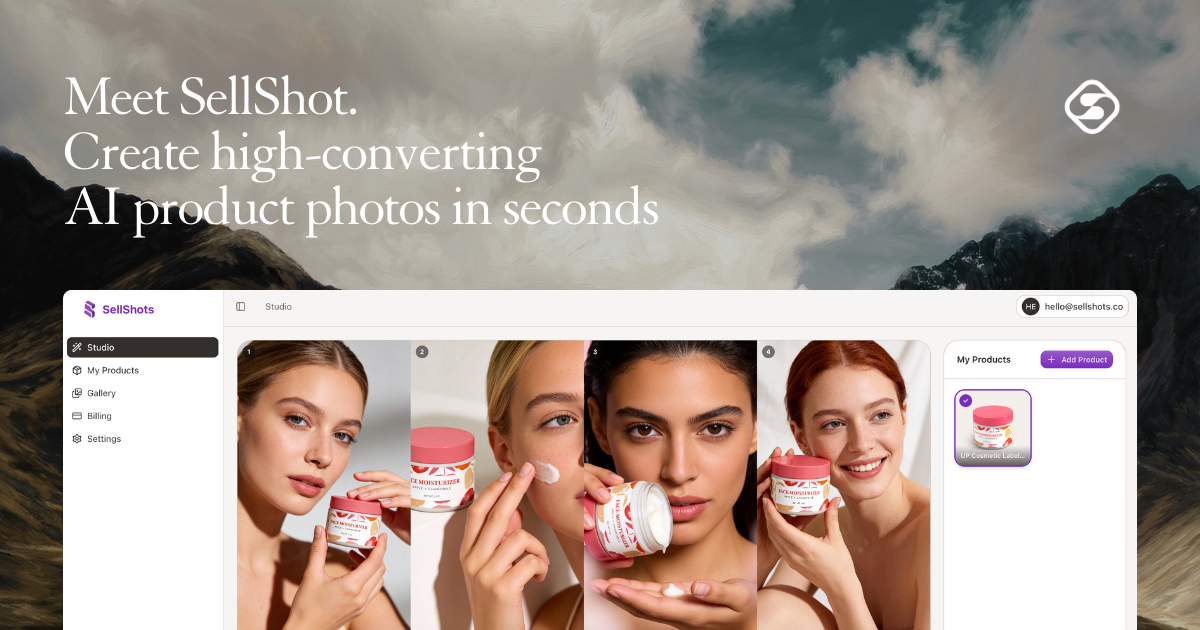
The pitch is simple. You upload one product photo. SellShots returns studio shots, lifestyle shots, and model shots. All of it formatted and ready for Amazon, Etsy, or Shopify. According to a Reddit post from what appears to be the SellShots team, you get 144 shots out of a single upload.
That number is doing a lot of work. If accurate, it’s a meaningful volume advantage over tools that give you five or ten variations and call it done.
The lifestyle and model shot angle is where it gets interesting to me. Background removal is table stakes in 2025. Anyone can cut your product out and drop it on a marble countertop. But generating a convincing model wearing or holding your product, without a model, without releases, without a shoot, that’s a harder technical problem and a more valuable output for apparel or accessory sellers especially.
According to a review on MakerStack, SellShots’s strongest alternative for sellers who also want video ads is CreatorKit, and Claid.ai is the better call on pure price-per-volume. That positioning implies SellShots is sitting somewhere in the middle, which is either a real differentiator or a squeeze play depending on how good the outputs actually are.
It got solid traction on launch day, which tells me there’s real demand here rather than founder enthusiasm alone.
I do want to flag what I can’t verify. The product website wasn’t accessible when I was pulling this together, and there’s no founder information in the research. So I’m working from the product description, Reddit posts, and third-party reviews. I can’t independently confirm the output quality, pricing structure, or exactly how the model-shot generation works under the hood.
For a tool where the output quality is literally the entire product, that matters. A lot of AI image tools look fine in screenshots and fall apart on your actual SKU.
The Verdict
SellShots is solving a real problem for a real audience. Small e-commerce sellers are underserved by expensive traditional photography and, honestly, a little overwhelmed by the number of AI tools that promise to fix it without being meaningfully different from each other.
Here’s the thing though. The competition is not sleeping. PhotoRoom has distribution, Claid has pricing, CreatorKit has video. Differentiating on volume, 144 shots per upload, is a reasonable bet, but only if the quality holds across product types. Apparel behaves differently than electronics. Ceramics behave differently than supplements.
I’d want to know two things at 30 days. First, what the actual output quality looks like on a range of product categories, not just the hero examples they’d put in a demo. Second, whether there’s any retention signal. Tools like this get tried immediately and abandoned quickly if the first three outputs aren’t usable.
What would make this work is laser focus on a specific seller type, say Etsy apparel or Amazon home goods, and owning that use case completely before going broad. What would make it fail is trying to be everything to every seller and ending up being the fourth-best option in every category.
I’ve been thinking about how much visual creative work is getting automated right now, from Claude generating slide decks inside PowerPoint to entirely new interfaces replacing the agency tab graveyard. Product photography was always going to be part of that wave. SellShots might be early enough to matter. I’m just not convinced yet.