













doraverse-s-all-in-one-ai-for-meetings
Meet in any language with live translations
Doraverse Wants to Be the Meeting Layer for Companies That Actually Span Multiple Countries
The Macro: The Meeting AI Market Is Crowded, But Not Solved
The productivity software market is enormous and still growing. Depending on which analyst you trust, it sat somewhere between $62.5 billion and $71 billion in 2024, with projections reaching $264 billion by 2034. The AI productivity tools slice specifically hit roughly $8.8 billion in 2024 and is tracking toward a 15.9% CAGR through 2033, per Grand View Research. I’m not citing those numbers to impress anyone. I’m citing them because this category has real enterprise money behind it, and that context matters.
Meeting intelligence is already a crowded subsection within that. Otter.ai has been doing automated transcription since 2016. Fireflies.ai, Fathom, and Notion AI all handle some version of notes plus action items. Zoom has AI Companion baked in. Microsoft Copilot lives inside Teams. Google Meet has its own summary tools. The incumbents aren’t scrappy startups. They’re the platforms themselves.
So where’s the actual gap?
Multilingual, mostly. Most of these tools were built for English-first workflows and bolted translation on later, when they bothered at all. For genuinely multinational teams, companies with engineering in one country, sales in another, and executives on a third continent, that’s not a minor limitation. The translation problem is the meeting. And 67% of AI decision-makers reportedly planned to increase generative AI investment in 2025, which means enterprise buyers are actively looking for tools that solve this at scale. Not just in demos. In actual use.
That’s the specific gap Doraverse is trying to occupy. Whether the gap is big enough, and whether they’re the right team to fill it, is a separate question.
The Micro: What Doraverse Actually Does in a Meeting
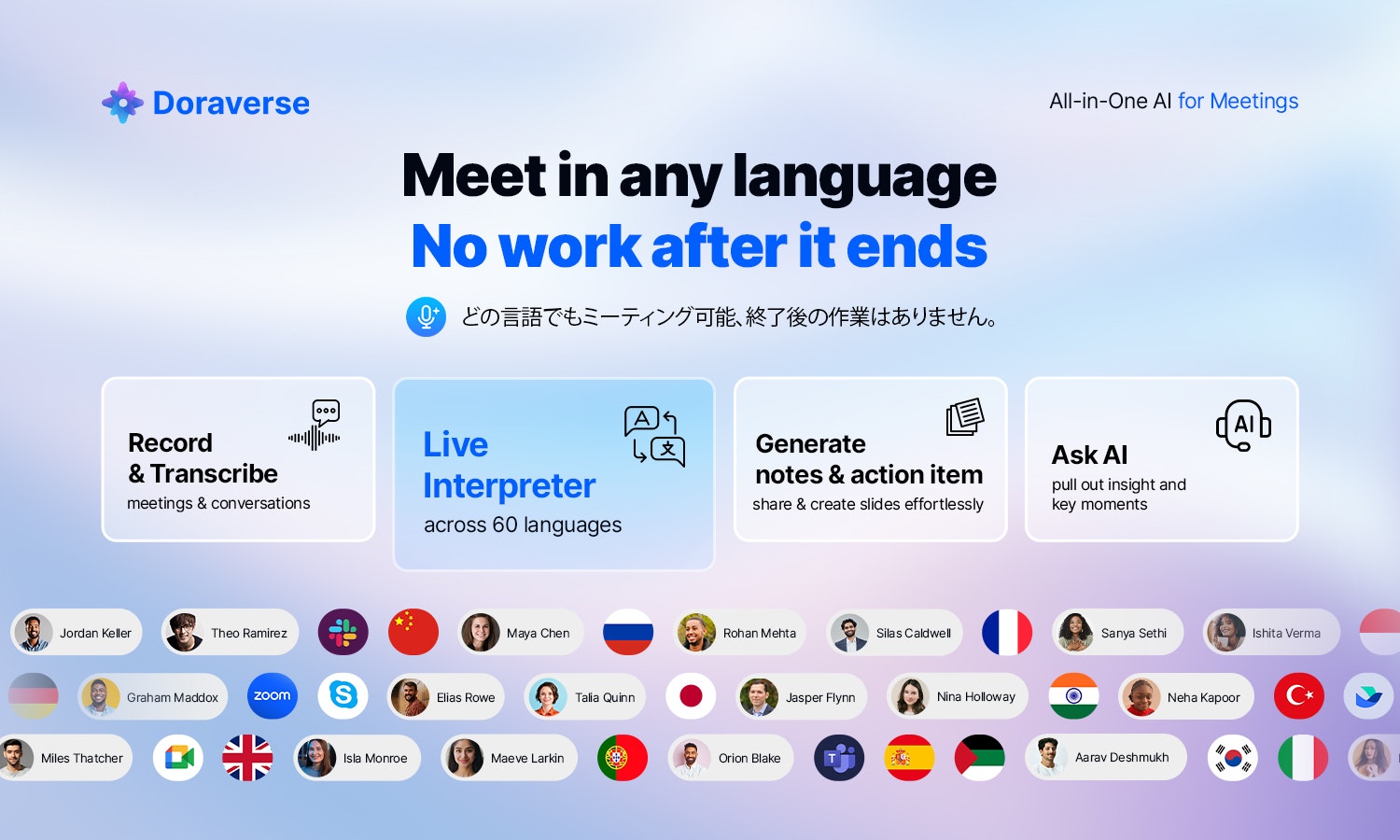
Doraverse is pitching its meeting feature set as part of a broader all-in-one AI platform for teams. The meeting product covers live translation across 60+ languages, automatic transcription, AI-generated notes and action items, and an in-meeting AI assistant you can query on the spot. It works with or without a bot joining the call, which is a real UX detail. Bot fatigue is real. Some platforms require a visible bot participant that attendees can see and silently resent, so the option to skip that is worth something.
The headline technical claim is 95% transcription accuracy, stated directly on the company’s website. That’s a competitive number. In practice, accuracy degrades with accents, crosstalk, and noise, which is exactly why Doraverse also mentions speech clarity enhancement and accent normalization as part of the stack. Whether those features hold up outside controlled conditions is the kind of thing you’d only learn after a few months of actual enterprise deployment.
Language detection is automatic. That matters more than it sounds. Asking users to manually set their language before a meeting is the kind of friction that quietly kills adoption. Notes and action items generate in the user’s preferred language rather than the speaker’s language. That’s the correct design decision for async follow-up in multilingual orgs.
It got solid traction on launch day. The positioning toward multi-region companies and the inclusion of enterprise-grade security as a default feature, not an upsell, suggests they’re serious about the enterprise buyer. That buyer asks about security before asking about features.
Founder Kim Ya is listed as co-founder and CEO, with a background that reportedly includes founding two previous startups. The company has a LinkedIn presence and offers a 14-day free trial with no credit card required.
The Verdict
Doraverse is making a reasonable bet. The multilingual meeting problem is real. The incumbents are genuinely English-centric. Enterprise buyers at multi-region companies have both budget and motivation. That’s a better starting position than most tools launching right now.
What would make this work at 30 days: retention signals from the free trial. Translation tools live or die on whether people actually use them in real meetings, not sandboxed demos.
At 60 days, the question is whether any named multi-region customer is willing to go on record. Testimonials from companies with operations across multiple countries would do more than any benchmark number. At 90 days, pricing clarity becomes critical, along with a clear answer to the Zoom Copilot question. Every enterprise buyer’s first objection is going to be some version of “why not just use what’s already inside our meeting platform.”
Before I’d fully endorse this, I’d want to know how the 95% accuracy claim holds across non-Western language pairs, what the actual bot experience looks like in practice, and whether the broader “all-in-one AI platform” framing helps or muddies the pitch. Trying to be everything to everyone in this market is a fast way to be nothing to anyone in particular.
The translation angle is sharp. That’s the thing I’d keep pulling on.
Also featured on HUGE: TamLabs Thinks AI Can Redesign Knowledge Work and They’re Starting with Professional Services · Vercel Wants to Own the Whole Stack, Not Just the Edge · OpenAI’s New Codex Helped Build Itself. That’s Either Impressive or a Warning Label.