





















chatwithads
From Data to AI-Assisted Decision, In One Conversation.
Your Ad Dashboard Has the Data. ChatWithAds Wants to Be the Person Who Actually Explains It.
The Macro: The Dashboard Is Not the Insight
Here’s something that has always bugged me about marketing analytics tools. They are extremely good at showing you numbers. Rows of them. Color-coded, even. And then they just… stop. The actual question, the one you opened the tab to answer, is still sitting there unanswered, somewhere between the bar chart and the export-to-CSV button.
This is not a niche complaint. The global digital marketing market hit $410.7 billion in 2024, according to ResearchandMarkets, and is projected to reach over a trillion dollars by 2033. Martech specifically was valued at $551.96 billion in 2025, according to Grand View Research, growing at a 20.1% CAGR through 2033. That is an enormous amount of tooling being sold to people who are, by all accounts, still confused about why their CPAs went up in Q3.
The honest version of this problem is that data visualization and data interpretation are two completely different skills, and most tools only do the first one.
AI-native analytics is the obvious attempt at fixing this. You have tools like Marpipe doing AI-generated creative testing at scale. You have the major ad platforms building their own AI layers (Meta’s Andromeda being the most-talked-about example right now). And you have a growing crop of SaaS products trying to sit on top of all your ad data and give you something more useful than a pivot table.
The category is getting crowded fast, which is why the product decisions at the layer between “raw ad data” and “useful answer” matter so much. The same translation problem shows up everywhere AI meets structured data, and the tools that actually win tend to be the ones that figure out the right conversational interface for their specific user, not just the most powerful model underneath.
Founders and small growth teams are a particularly interesting target here. They have real money in ads, real consequences when things go wrong, and zero time to become BI analysts.
The Micro: Just Ask It Why Your Ads Are Broken
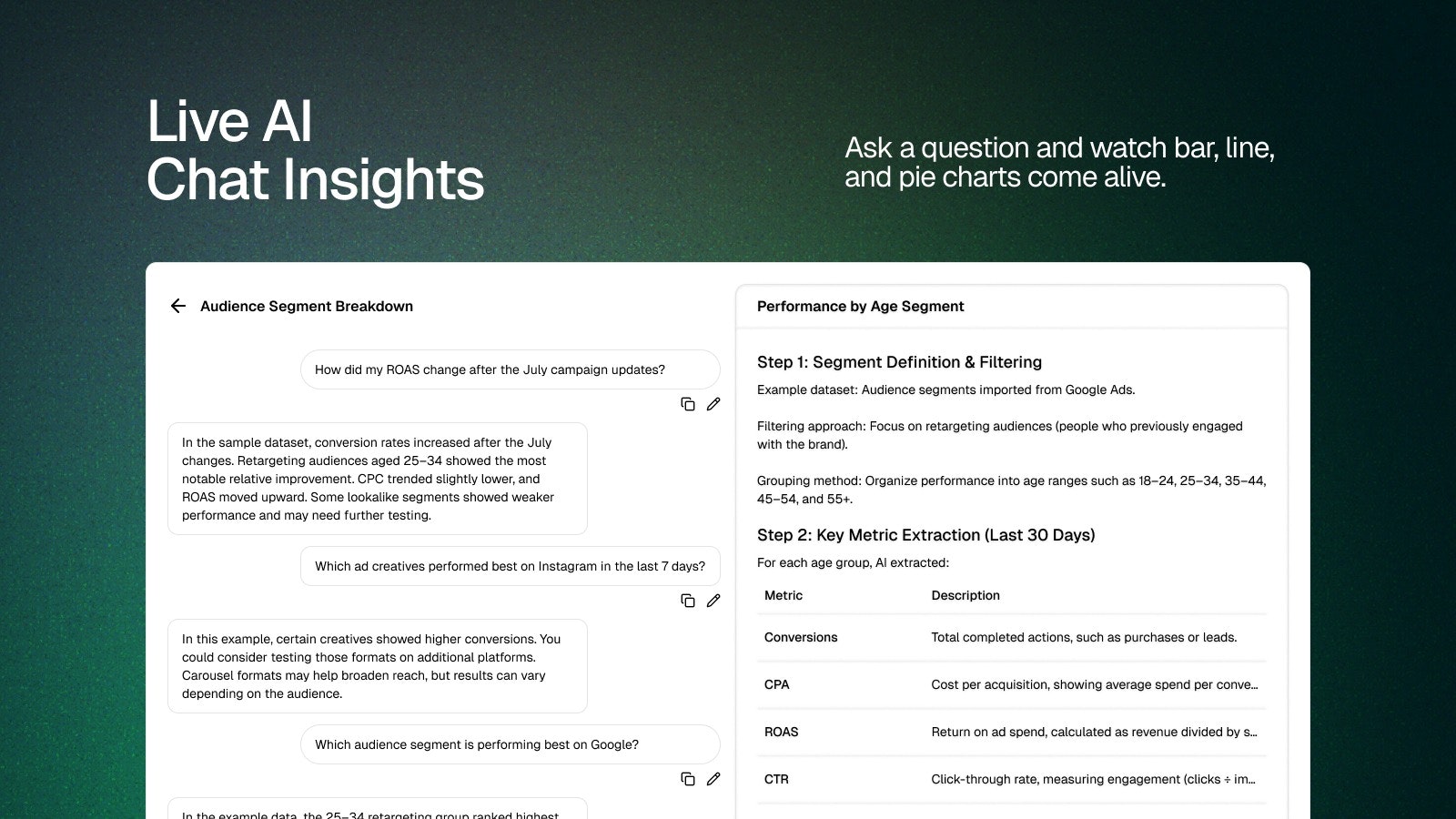
ChatWithAds is a conversational analytics tool built specifically for ad data. The pitch is simple: instead of opening four dashboards and a spreadsheet, you just ask a question in plain language and get an answer you can act on.
According to LinkedIn posts from co-founder Saswat Panigrahi, the core insight behind the product is that most analytics tools tell you what happened but not why, and the gap between those two things is where decisions get delayed and money gets wasted. Panigrahi comes out of digital advertising with Google Ads and Shopify experience (his profile mentions $5M+ in revenue scaled). Co-founder and CEO Sunny Dodeja has been running Global Digital Online since 2017, according to his LinkedIn profile, and lists ChatWithAds as a separate venture started in January 2025.
So these are not two ex-Googlers who just discovered that marketers use spreadsheets. They have spent time inside the problem.
The product targets founders and growth teams specifically. Not enterprise analytics orgs with dedicated data teams. The people who are wearing multiple hats and need an answer by EOD, not a ticket filed with the BI team.
What the actual interface looks like under the hood, I can’t fully confirm since the product website wasn’t accessible for this piece. But the described mechanic is straightforward: connect your ad and business data, ask questions conversationally, get actionable outputs. Think less “AI that generates dashboards” and more “AI that reads the dashboard and talks to you about it.”
It got solid traction when it launched, landing at #10 for the day.
The product direction feels adjacent to where a few other conversational-interface tools are heading. There’s been a broader push toward replacing form-based inputs with natural language across a lot of SaaS categories, and ad analytics is one of the more obvious places for that shift to happen. The question is always execution depth, not concept validity.
The Verdict
I think the problem is real. Anyone who has managed ad spend for a company, even a small one, knows the feeling of having all the numbers and none of the clarity. The conversational layer idea is not new, but the specificity of the target user here is actually a smart call. Founders and lean growth teams are a genuine ICP, not a marketing line.
What I’d want to know at 30 days: which ad platforms can you actually connect, and how deep does the integration go. “Ad data” is doing a lot of work in that tagline. If it’s Google Ads and Meta and that’s it, fine, that’s most of the market. If the query layer is just calling GPT-4 on top of a CSV export, that’s a different product than it sounds like.
At 60 days, I want to see retention signals. Conversational analytics tools are very easy to try once and forget about. The stickiness question is whether the answers are good enough that you trust them, and whether the product earns a place in your actual weekly workflow.
At 90 days, the competition problem gets real. The big ad platforms are not sitting still on this. If Claude can live inside PowerPoint, it’s not a stretch to imagine it sitting on top of your Google Ads account directly. ChatWithAds needs a distribution or integration moat, and it needs it before the platforms close the gap themselves.
The founders have real operator credibility. That’s worth something. I’m just not sure it’s enough on its own.