




















skyvern-mcp-skills
Let Claude code and Open Claw automate the web
Skyvern Wants Your AI Agent to Stop Babysitting the Browser
The Macro: The Browser Is Still the Last Mile Nobody Wants to Own
Here’s the part that doesn’t get talked about enough. AI coding agents have gotten genuinely impressive at writing business logic, chaining API calls, structuring data pipelines. But the moment a workflow touches a real website, one that doesn’t have an API, one that maybe changed its login flow last Tuesday, everything falls apart. You end up babysitting the browser yourself.
This is not a niche problem. A massive chunk of real business automation still lives in forms, portals, and web UIs that were never designed to be touched by anything but a human hand. The companies trying to solve this are working in roughly two directions. Some are building better scraping and interaction primitives (think Playwright wrappers with AI sprinkled on top). Others are trying to go one layer higher and make the automation itself an agent-native primitive, something that can adapt when the page changes without requiring a human to come fix it.
Skyvern has been in the second camp since its early days as a YC S23 company. The original product was already doing AI-driven browser automation. What’s interesting now is how they’re thinking about where that capability slots into an agentic stack.
The competitive space here is real. OpenClaw has attracted a following, and alternatives are multiplying fast, with Activepieces and Retool targeting adjacent use cases from the workflow automation side. Cline, which we’ve covered before, is pushing hard on agentic coding workflows in the IDE. The pattern across all of them is the same: agents need infrastructure that handles the messy, stateful, failure-prone parts of the world so the agent’s reasoning layer doesn’t have to.
That’s the opening Skyvern is trying to walk through.
The Micro: Sub-Agents That Learn the Website So Claude Doesn’t Have To
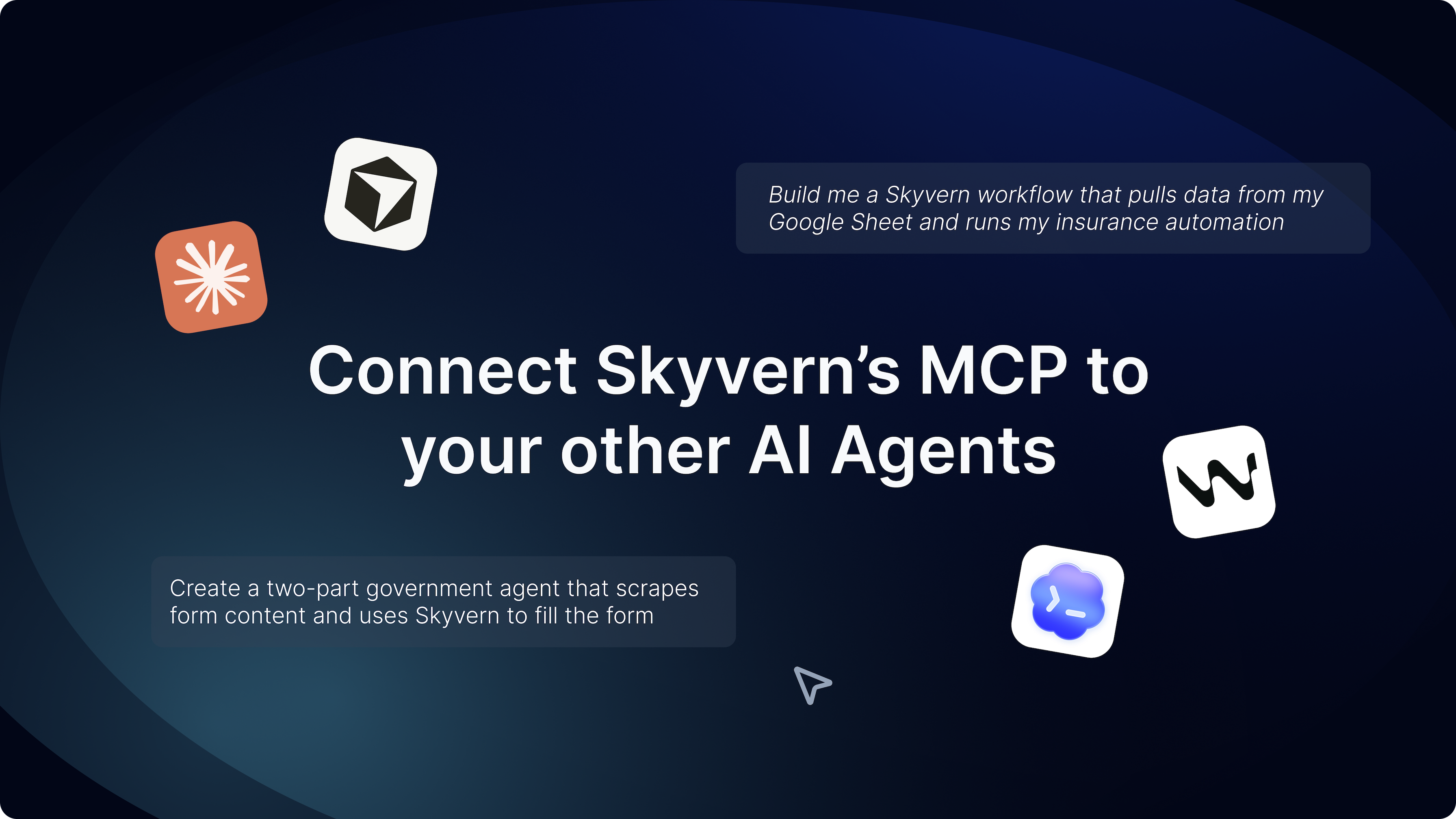
The actual product here is an MCP server, a Model Context Protocol integration that lets Claude Code and OpenClaw hand off browser tasks to Skyvern entirely. You’re not prompting a browser. You’re not writing Playwright scripts. You’re telling your agent “go do this thing on this website” and Skyvern figures out the rest.
The specific mechanics are worth understanding. When your agent hits a website it hasn’t seen before, Skyvern’s sub-agents learn the site, register a new automation for it, and then maintain that automation going forward. The key word is maintain. If the site updates its UI, Skyvern’s supposed to adapt without you rewriting anything. That’s the claim that matters most, and also the hardest one to evaluate from the outside.
It’s open source and lives on GitHub, which is a deliberate choice. The kind of developer who’s already running Claude Code against their workflows is going to want to read the code before they trust it with production tasks. Keeping it open is table stakes for that audience.
The MCP angle is smart positioning. MCP has been having a moment, and a lot of agentic tooling is racing to become a first-class integration before the standard hardens. Getting in early as the browser automation layer for Claude Code specifically is a reasonable bet. MiniMax and others are making similar bets on the infrastructure layer right now, just in different directions.
It did well when it launched, which tracks. The problem space is real and the developer audience gets it immediately.
What I don’t know yet is how robust the maintenance loop actually is. “Sub-agents will maintain automations for you” is a big promise. The failure mode, where a website changes in a weird enough way that the sub-agent confidently does the wrong thing, is the failure mode that matters.
The Verdict
I’m genuinely interested in this, which is not something I say about every browser automation pitch. The MCP integration is well-timed, the open source approach is right for the audience, and the core idea, offloading website-specific learning to a layer below the main agent, is architecturally clean.
But the 30-day question is: does the maintenance promise hold in production? Any developer who has tried to keep a Selenium suite alive against real websites knows how fast things break. Skyvern’s entire value proposition rests on whether the sub-agent loop is actually resilient or just resilient enough to look good in a demo.
At 60 days, I’d want to see community reports from people running this against real workflows, not toy examples. GitHub issues will tell you more than the landing page.
At 90 days, the question is whether they get traction with the Claude Code user base specifically or end up being a general automation tool that never found its people. According to the research, Skyvern has raised $2.7M, which means there’s some runway to find out.
The founders came out of YC and have been iterating publicly. That’s a decent sign. I just want to see the part where a random government portal changes its form layout and Skyvern doesn’t lose the plot.