elevencreative-by-elevenlabs
The AI creative platform to bring your content to life
ElevenLabs Wants to Be the Only Creative Tool You Open
The Macro: The All-in-One Trap and Why Everyone Keeps Falling Into It
The awkward truth about AI creative tools right now is that the best ones are all specialists. You go to one place for voice, another for music, another for video generation, another for sound effects. The workflow is a mess of browser tabs and export files and “wait, which version did I use for this?”
That fragmentation has become genuinely expensive. Not just in time, but in the compounding friction of context-switching between tools that don’t talk to each other.
So the pitch for consolidation makes sense. And it has attracted serious capital. Corporate AI investment hit $252.3 billion in 2024, according to Stanford’s AI Index, a 44.5% jump from the prior year. That money is landing everywhere, including on the exact problem ElevenCreative is trying to solve. Runway, Adobe Firefly, Canva’s AI suite, Pika, and a growing cluster of video-first tools like Prism, which lets you run six video models side by side in a single editor, are all circling the same territory: give creators fewer reasons to leave your product.
The difference is where each company started. Adobe started with professional editing. Canva started with templates. Runway started with video generation. ElevenLabs started with voice.
That origin matters. Voice was the thing that actually made ElevenLabs credible. Their text-to-speech output was, for a meaningful stretch of time, noticeably better than what anyone else had. That reputation is the asset they’re building on. The question is whether “we’re good at audio” translates into “we’re good at everything audio touches,” which is a much larger and more contested claim.
The Micro: What It Actually Does When You Open It
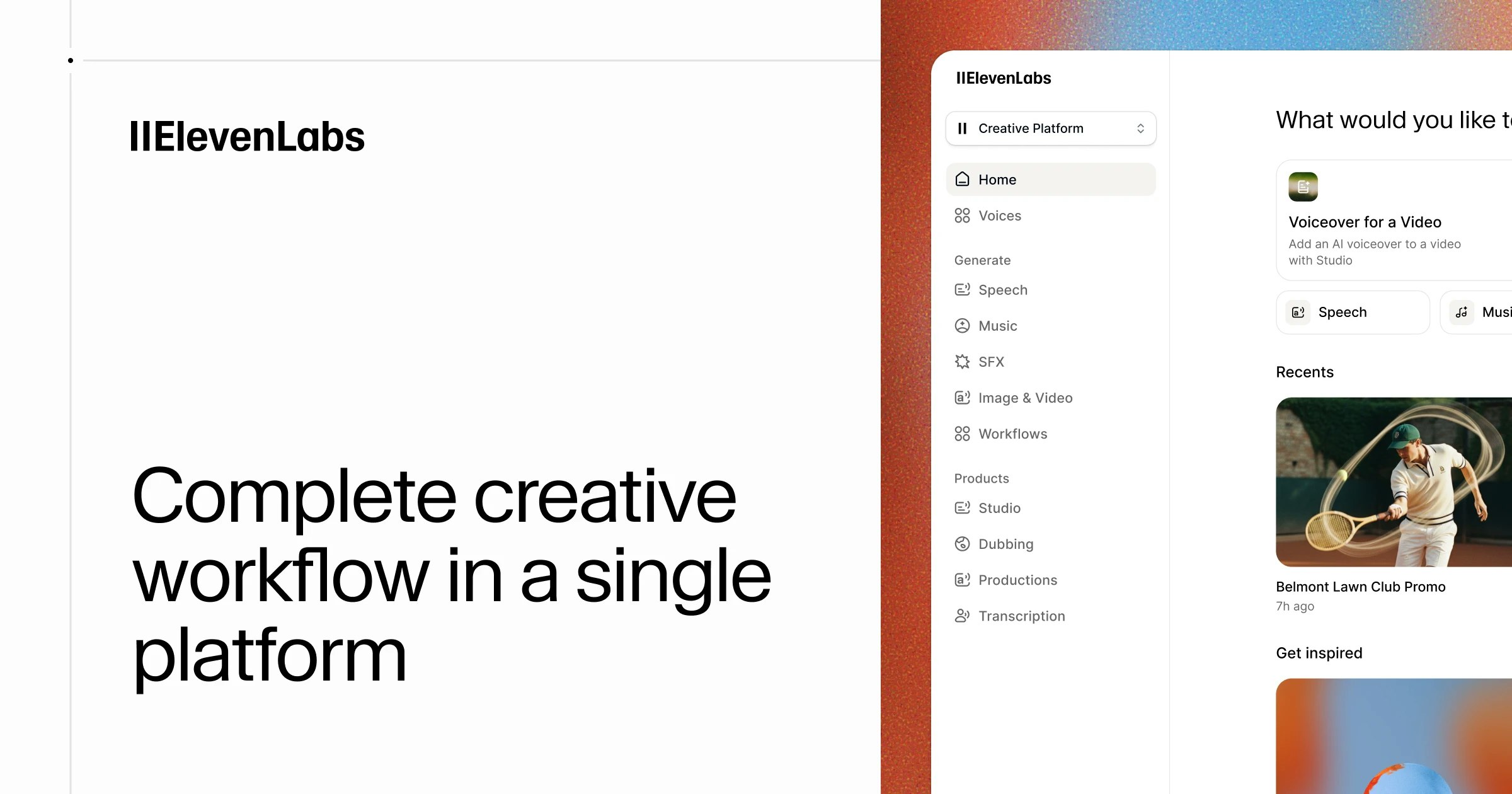
ElevenCreative is, structurally, a hub. You come in with an idea and the platform offers you multiple generation modes depending on what you’re trying to make. Voiceovers from text. AI-generated music that fits a specific mood or genre. Sound effects generated from a description. Video created from images or simple inputs. UGC-style ad content. Localization that adapts the whole package for different languages and markets.
The localization piece is the most interesting one to me.
Generating a voiceover in English is table stakes now. Generating that same voiceover in twelve languages, with appropriate timing, synced to existing video, and with voices that don’t sound like a robot reading a phone menu, is a different problem. That’s where the accumulated voice model work actually earns its keep in a product like this.
Co-founder Mati Staniszewski posted about a feature called Flows, described as a node-based creative canvas, which is the kind of thing that sounds technical but is basically a visual workflow builder. Connect inputs and outputs in a diagram rather than navigating linear menus. For marketing teams managing multi-format campaigns across multiple markets, that matters. It reduces the number of steps between a brief and a finished asset.
The platform also generated solid early traction when it launched, picking up attention across the builder community quickly.
What I’d want to understand better is the video generation quality relative to dedicated tools. Cardboard’s approach of turning raw footage into finished video from a single prompt is compelling precisely because it stays narrow and sharp. ElevenCreative is doing the opposite, going wide. Wide can work. But it asks every individual module to hold up under comparison to products that only do one thing.
The AI voice quality is the credibility anchor here. If the music, video, and SFX outputs are good enough, the platform case holds. If they’re noticeably weaker than the voice work, the whole thing starts to feel like a company that got distracted by its own ambitions.
The Verdict
I think ElevenCreative is a real product with a real argument behind it, not a feature dressed up as a platform.
The consolidation play is legitimate. If your entire job involves moving audio and video through multiple production stages and markets, fewer tools genuinely helps. ElevenLabs has the voice credibility to make the pitch without it sounding hollow.
What I’m skeptical about is execution depth across the full suite. The history of all-in-one creative platforms is not encouraging. Most of them end up excellent at one thing and acceptable at five others, and professionals learn quickly which is which.
At 30 days I’d want to see retention data from marketing teams actually using the localization workflow, because that’s the use case where the full-stack argument is strongest. At 60 days I’d want to know whether video generation quality is closing the gap with focused competitors or staying behind them. At 90 days the question is whether anyone is actually canceling other subscriptions because of this, or just adding it to the tab pile.
The data question I can’t answer from the outside: what percentage of their reportedly millions of users are touching the video and music tools versus just the voice features. That number would tell me everything about whether this is a platform or a voiceover tool with nice upsells. I genuinely don’t know yet. That’s not a hedge. That’s just the honest position to be in right now.