













tama96
A Tamagotchi for your desktop, terminal, and AI agents
tama96 Turns Your AI Agent Into a Pet Owner, Which Is Either Charming or a Warning Sign
The Macro: Nostalgia Is Easy, the Infrastructure Bet Is the Real Story
The virtual pet genre has never really died. It just went dormant, periodically revived by Nintendogs, Neopets holdouts, and a generation of developers who grew up watching a pixelated egg hatch on a keychain. The gaming market itself is enormous and getting larger. According to Newzoo, global games revenues hit $188.8 billion in 2025 across 3.58 billion players. BCG puts the total figure closer to $263 billion when you account for broader definitions. Either way, the numbers are not the interesting part for a free, open-source virtual pet.
The interesting part is where tama96 plants its flag. It’s not competing for a slice of console revenue or mobile ad dollars. It’s sitting at the intersection of developer tooling and retro gaming, which is a strange place to stand, but not a stupid one.
The real context here is the Model Context Protocol. MCP is the emerging standard that lets AI agents interact with external tools and services in a structured way. Anthropic introduced it, and adoption among developer-focused products has been fast. I’ve written about this pattern before in different forms. ByteRover is betting that AI agent memory is fundamentally a file system problem, and Fowel is using similar agent tooling to keep documentation from becoming a legal liability. The through-line is that developers are building real infrastructure on top of MCP, and they need low-stakes environments to understand how that infrastructure actually behaves.
A virtual pet is a low-stakes environment. Feed it, play with it, watch it die if you ignore it. The feedback loop is tight, the consequences are zero, and the mechanic is universally understood. That’s not an accident.
The Micro: One Binary, Three Interfaces, and a Pet That Your Claude Instance Can Kill
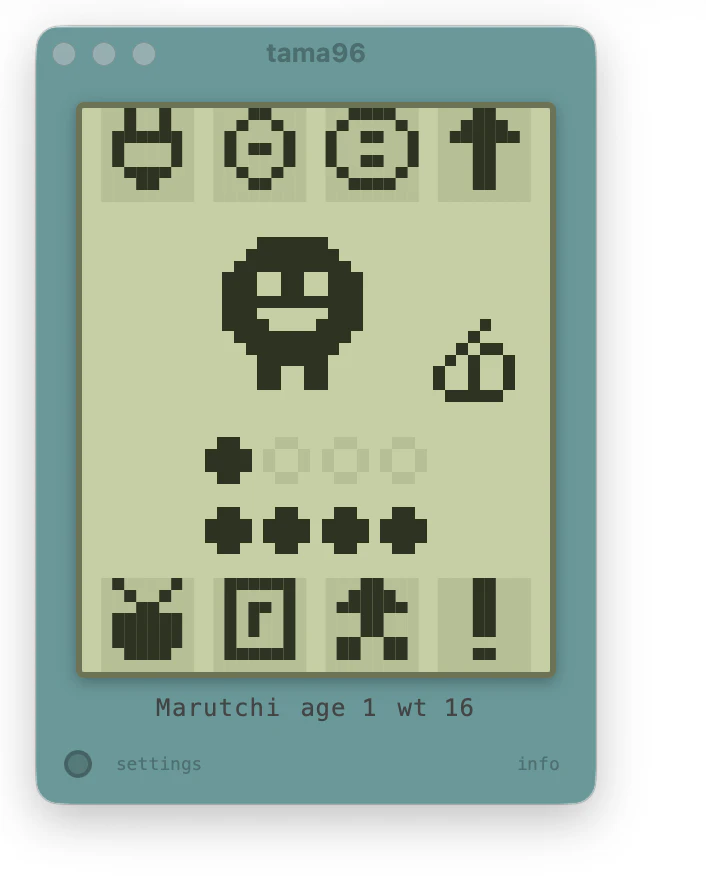
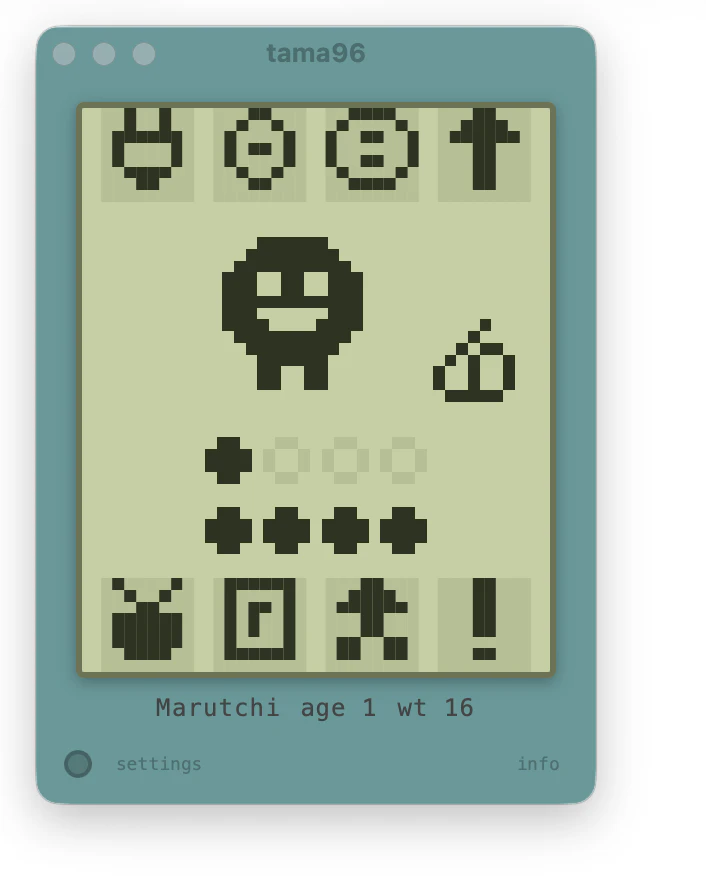
tama96 is a virtual pet inspired by the original 1996 Tamagotchi P1. You care for it. It has needs. If you neglect it, presumably something bad happens to it. The pixel LCD aesthetic is intact.
But the product has three distinct modes, which is the actually interesting thing about it.
The desktop client gives you a pixel-accurate LCD display with clickable icons, a system tray presence, and an always-on-top window so your pet is never fully out of sight. Background ticks keep the pet’s state updating even when you’re not actively interacting. Notifications tell you when it needs attention. This is the version for people who want the nostalgic experience with some quality-of-life improvements.
The terminal client is a single binary with zero dependencies. You can run it standalone or connect it to the desktop client. This is the version for developers who would rather interact with a pet via keyboard than click a pixel icon, which is a specific kind of person and tama96 is clearly built by one of them.
Then there’s the MCP server, which is the part that makes this genuinely strange and interesting. Through the Model Context Protocol, AI agents can feed, play with, and care for your pet directly. The permissions model is per-action, and there are rate limits built in. So you could, theoretically, give your Claude instance the ability to keep your pet alive while you focus on something else. Or you could set up an agent workflow where pet care is a background task that tests whether your MCP configuration is correctly scoped.
It got solid traction when it launched, landing in the top ten for the day.
The GitHub-first distribution and the free price point mean the barrier to trying this is basically zero. That’s a smart call for something this weird. You don’t pitch a virtual pet for AI agents. You just let developers find it and figure out what they want to do with it.
The Verdict
I’ll be direct. tama96 is not a business in any conventional sense. It’s an open-source project that happens to be an excellent demo of what MCP tooling can do when the use case is approachable enough that you actually want to interact with it.
That’s worth something real. The hardest part of getting developers to learn new infrastructure patterns is giving them a reason to care. A pet that dies if your agent misbehaves is a reason to care. It’s also a reason to think carefully about rate limits and permission scoping, which is exactly the behavior you want developers practicing before they point agents at anything consequential. OpenUI ran into similar dynamics when trying to get developers to engage with AI interface tooling before they had real production pressure to do so.
At 30 days, I’d want to know how many people are actually using the MCP integration versus the desktop client. At 60 days, whether anyone has built something unexpected on top of it. At 90 days, whether the project is still maintained at all, because solo open-source projects with no revenue model have a predictable arc.
The concept is smart. The execution, based on what’s described, sounds clean. The question is whether this is a project or the beginning of something else. I genuinely don’t know, and I think the makers might not yet either.