














helply
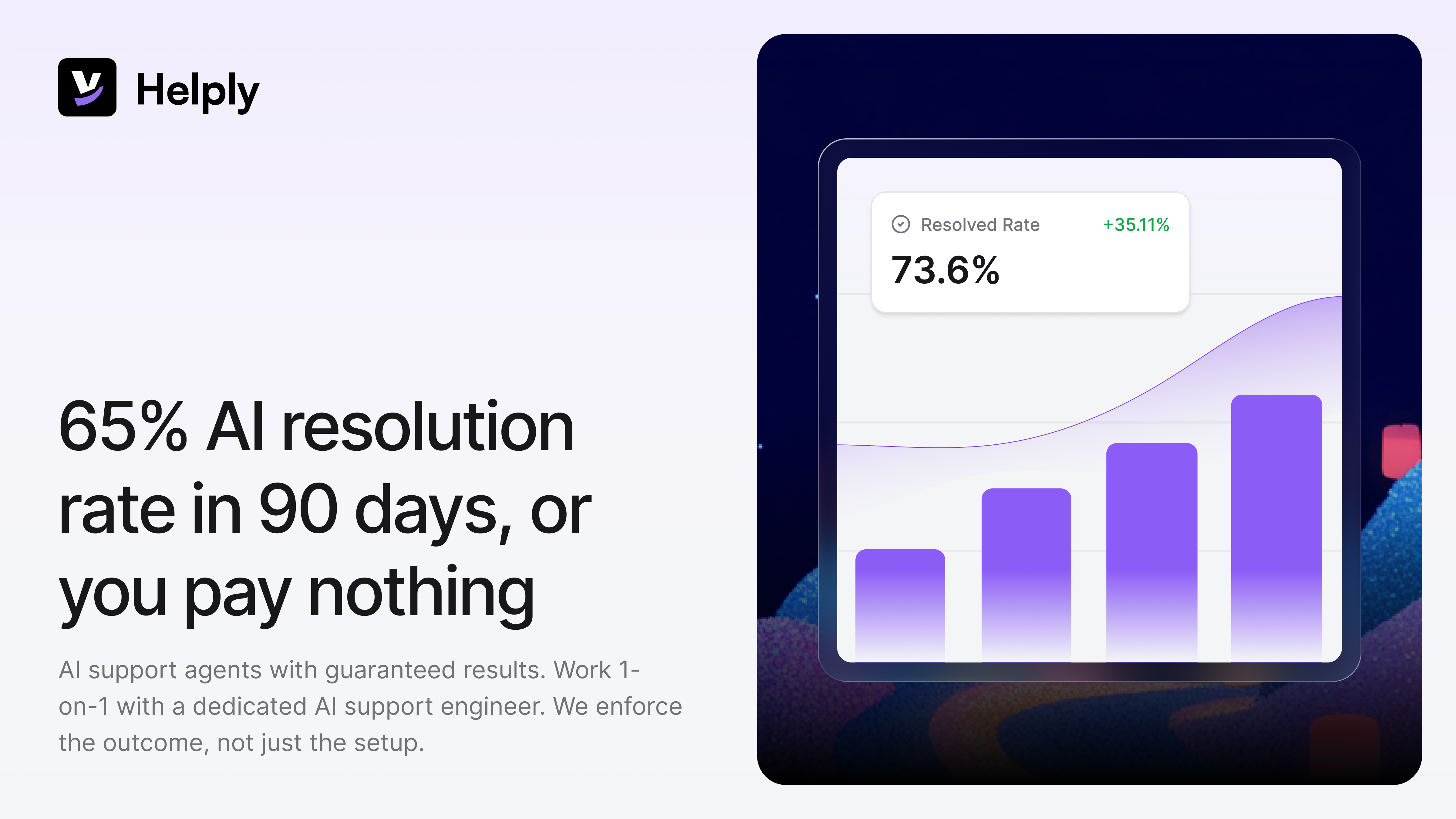
65% AI resolution rate in 90 days, or you pay nothing
Helply Bets Its Business Model on a Number: 65%
The Macro: Everyone Wants to Fire Their Support Queue
Somewhere between the third Zendesk price increase and the fourth consecutive quarter of support headcount growing faster than revenue, a lot of SaaS founders started asking whether human-first customer support was structurally broken. The timing of AI support tools flooding the market is not a coincidence.
The numbers behind this are real. Multiple research firms peg the customer success platforms market at roughly $1.86 billion in 2024, with projections ranging from $9 to $9.17 billion by 2032 — a CAGR hovering around 22%. That kind of growth rate tends to mean one of two things: either the category is genuinely expanding, or analysts are being optimistic in a frothy sector. Probably some of both.
What’s actually driving the urgency is simpler than market reports make it sound. Support tickets are expensive, repetitive, and deeply unpleasant to staff at scale. The median SaaS company is handling a support queue that’s roughly 60-70% the same dozen questions asked in slightly different ways. That’s a solvable problem, in theory — and every major player in the space has noticed.
The competitive landscape Helply is entering is not empty. Intercom has Fin, its AI agent layer, which has been live and iterating for over a year. Zendesk has acquired and built its own AI resolution tooling. Freshdesk, Help Scout, Gorgias — all have some version of AI-assisted or AI-first support baked in now. The incumbents have distribution, existing customer data, and integrations already in place.
Helply’s position in this crowd is essentially: we don’t just sell you the gun, we guarantee you hit the target. That’s a different bet than most of its competitors are making, and it’s either clever differentiation or an uncomfortable promise to keep, depending heavily on what happens in month three.
The Micro: The Guarantee Is the Product
Helply is an AI support agent — it handles support conversations end-to-end, takes actions inside connected systems, syncs with your existing help desk, and escalates to humans when needed, passing along full context and source citations so the handoff isn’t a mess. The demo conversation on their site shows it fetching invoices, surfacing prorated billing details, and doing the small helpful things that eat up a support rep’s afternoon.
None of that is technically novel in 2025. What Helply is actually selling is the 65% resolution rate in 90 days or you pay nothing. That’s the product. The AI agent is the mechanism; the outcome guarantee is the offer.
To make that guarantee work operationally, they’ve built around a dedicated AI support engineer assigned to each customer — a human layer that sits between the software and the outcome. The implication is that setup, training, and tuning aren’t left to the customer to figure out. Someone is accountable for whether the number gets hit. That’s a real structural decision, and it costs money to run, which means their unit economics are interesting to think about (even if we don’t have the numbers to think about them with).
Helply claims to be trusted by 1,000+ businesses, and their Product Hunt launch logo wall includes names like Streak, Churnkey, and Kami — recognizable SaaS-adjacent brands, not just placeholder logos. The PH launch itself landed at #4 for the day, with 335 upvotes and 99 comments — a respectable showing that suggests genuine interest rather than a coordinated clap circle.
Alex Turnbull is listed as a founder — the same Alex Turnbull who founded Groove, a help desk product with its own established user base in the SMB SaaS segment. If that connection is as direct as LinkedIn suggests, Helply isn’t starting from zero on domain credibility or distribution. That matters in a market where trust is the actual product.
The Verdict
The guarantee is doing a lot of work here, and the question is whether it’s load-bearing or decorative. A 65% resolution rate is a specific, auditable claim — which is good. The 90-day window is long enough for a genuine implementation cycle, but also long enough that a lot can go wrong quietly before anyone calls the bet.
What would make this work: a genuinely tight onboarding process where the dedicated engineer model actually closes the gap between ‘installed’ and ‘performing,’ combined with a customer base that has reasonably high-volume, pattern-heavy support queues where AI resolution rates are achievable. B2B SaaS billing questions, password resets, integration FAQs — that’s the sweet spot.
What would make this hard: customers with complex, nuanced, or low-volume support scenarios where 65% is structurally unreachable, or a unit economics model where the engineer layer costs more to run than the guarantee allows.
Turnbull’s Groove background is the most reassuring signal here — building in this space for the second time, with presumably hard-won knowledge of where AI support actually succeeds and where it embarrasses you in front of a customer.
We’d want to see the refund rate at month four before calling this a durable business. But the bet is coherent, the positioning is sharp, and the guarantee is at least a real one. That’s more than most launches can say.