














straude
Strava for Claude Code, the global tokenmaxxing Leaderboard
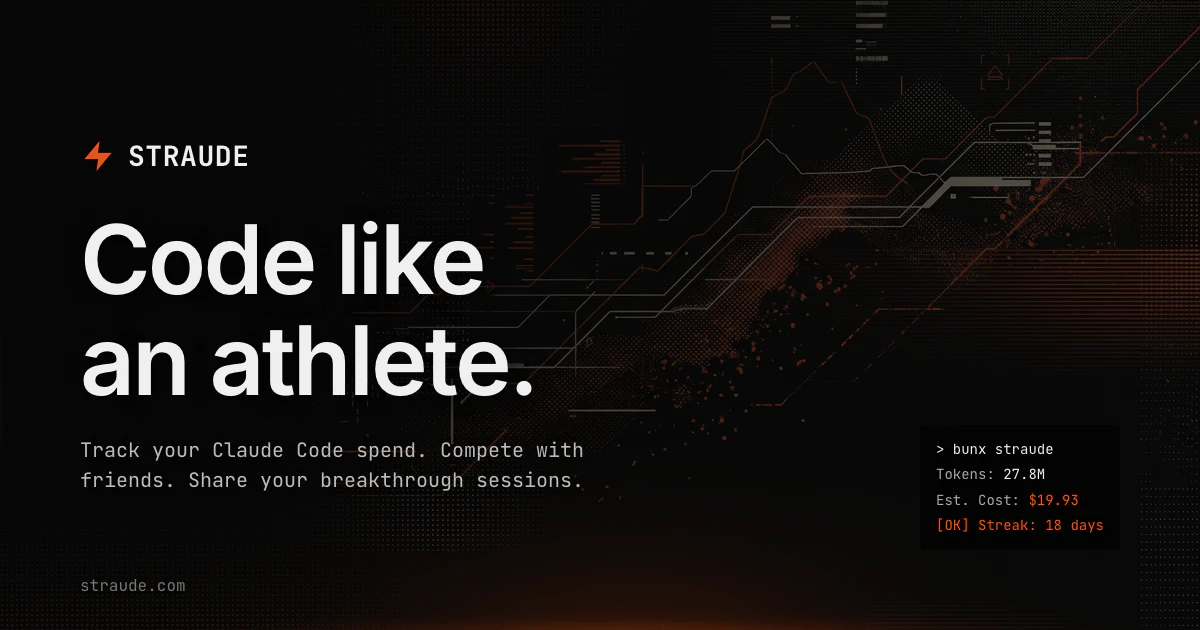
Straude Wants to Turn Your Claude Spend Into a Sport
The Macro: The Part Where Developers Started Competing Over How Much They Spend
Something shifted in how developers talk about AI tooling over the last year. It stopped being about whether to use it and started being about velocity. How fast are you iterating? How many agents are you running? Garry Tan is apparently cooking for 20 hours a day. The discourse around Claude Code specifically has taken on this faintly athletic quality, builders talking about token budgets the way runners talk about weekly mileage.
The productivity software market is enormous and still growing fast. Multiple sources put the broader segment somewhere between $62 billion and $71 billion currently, with projections climbing well past $140 billion within the next decade. That number is almost too large to mean anything useful. What it does tell you is that there is serious commercial gravity around tools that help people work better, or at least feel like they are.
The more interesting subset is developer tooling specifically. We have seen a wave of products built on top of AI coding assistants, each trying to solve a slightly different friction point. Zoer.ai argues the vibe coding era built its core problem into the foundation, and there is something to that. The complaint is not that AI coding tools are bad. The complaint is that they are opaque. You spend real money, produce real output, and have almost no structured way to understand what happened or compare it to anything.
Strava solved a version of this problem for runners in 2009. It did not make running faster. It made running legible and social. Splits, segments, leaderboards. The insight was that people work harder when they can see their own data and when someone else can see it too.
Straude is betting that the same psychology applies to software engineers burning through Claude tokens at scale.
The Micro: One Command, a Leaderboard, and a List of Companies With Unlimited Tokens
The core product is telemetry for Claude Code sessions. You install it, run one command, and Straude starts logging your spend, session data, and streaks. The pitch is real-time token counting and cost attribution per session, plus velocity metrics that let you see how fast you iterate compared to what they call global baselines.
That last part is where it gets interesting and slightly strange. Straude is not just a personal dashboard. It is a leaderboard. You are being ranked against other builders worldwide on something called pace. The gamification is deliberate and pretty naked about it. The tagline is literally “code like an athlete.”
There is also a feature called the Prometheus List, which is a public ranking of companies by how much access to tokens they give their teams. Nvidia is at the top. Resend, Notion, and Ramp are listed as offering unlimited access. It is a clever piece of social engineering. If your company is not on the list, that is a data point. If it is, that is something you can share.
The streak mechanic is worth pausing on. Daily commits are not enough, the site says. You need to maintain your AI engineering streak. This is very much Duolingo logic applied to developer tooling, and I think that is a legitimate design choice. Streaks work. They are annoying, but they work.
It got solid traction on launch day, which is a signal worth something even if it is not conclusive.
The product positions itself adjacent to the broader conversation about Claude Code moving toward more autonomous operation, which means the audience Straude is targeting is growing whether or not Straude specifically grows with it. That is a decent tailwind.
What I do not know yet is how deep the data actually goes. Pace and spend are table stakes. The question is whether the comparisons are meaningful enough to change behavior.
The Verdict
Straude is a small, sharp bet on a real observation. Developers using Claude Code at scale have no good way to understand their own patterns, and almost no social infrastructure around the work. Straude is trying to build both at once.
The Strava analogy is doing a lot of lifting here. Strava worked because running data is inherently comparable. A 7-minute mile means something universal. Token spend and velocity are messier. Two engineers with radically different projects will produce numbers that are hard to put next to each other with any meaning. If Straude cannot solve the comparison quality problem, the leaderboard becomes noise and the streaks become the only retention hook. Streaks alone will not hold a developer audience for long.
At 30 days I want to know whether the velocity benchmarks feel honest to users who actually build complex things, not just toy projects. At 60 days I want to know whether any teams are adopting it, because individual developer tools live and die on whether they cross into team context. Syntropy’s approach of fitting into existing team workflows is a useful contrast here.
The Prometheus List is the most interesting thing they have built. A public ranking of company generosity with AI resources is genuinely useful information that does not exist anywhere else right now.
I would use the dashboard. I am less sure I would care about the leaderboard after the first week.