














riffle-3
An infinite, collaborative playground for music creation
Riffle Thinks Music Creation Is Broken. It Might Be Right.
The Macro: Music Software Told Producers to Become Engineers. That Was a Mistake.
Here’s the thing about music creation software: it has spent thirty years getting more powerful and, quietly, more alienating. Ableton is extraordinary if you’re willing to apprentice yourself to it for six months. GarageBand is friendly until the moment you want to do something real. The gap between those two things is where most people give up, and it’s where a genuinely interesting product conversation is happening right now.
The instinct from most tools has been to add. More plugins. More routing options. More ways to do the thing you already couldn’t figure out how to do. Which, look, that works great for the producer who wants granular control over every millisecond of a hi-hat. It does almost nothing for the person who just wants to make something with their friends on a Tuesday night.
Collaborative music creation is the underappreciated part of this. I’ve been watching a few products try to solve it from different angles. GoRiff is approaching it from the production workflow side, positioning itself as infrastructure for the people who already know what they’re doing. That’s a coherent bet. But it leaves the same people stranded that Ableton left stranded.
The AI angle is where things get genuinely complicated. Every music tool with a pulse is bolting on generation features right now, and most of them feel like a microwave in a restaurant kitchen. Present but not the point. The smarter teams are using AI to reduce friction rather than replace the human doing the creating, and that distinction matters more than most launch posts will admit.
Timing-wise, I think this space is early in a good way, not in a “nobody is ready for this” way. People are more comfortable making things in browsers, more comfortable with collaborative creative tools, and frankly more bored of watching professionals make music than actually trying to make it themselves. That’s a behavioral shift worth building toward.
The Micro: An Infinite Canvas, a Sous Chef, and a Very Specific Vibe
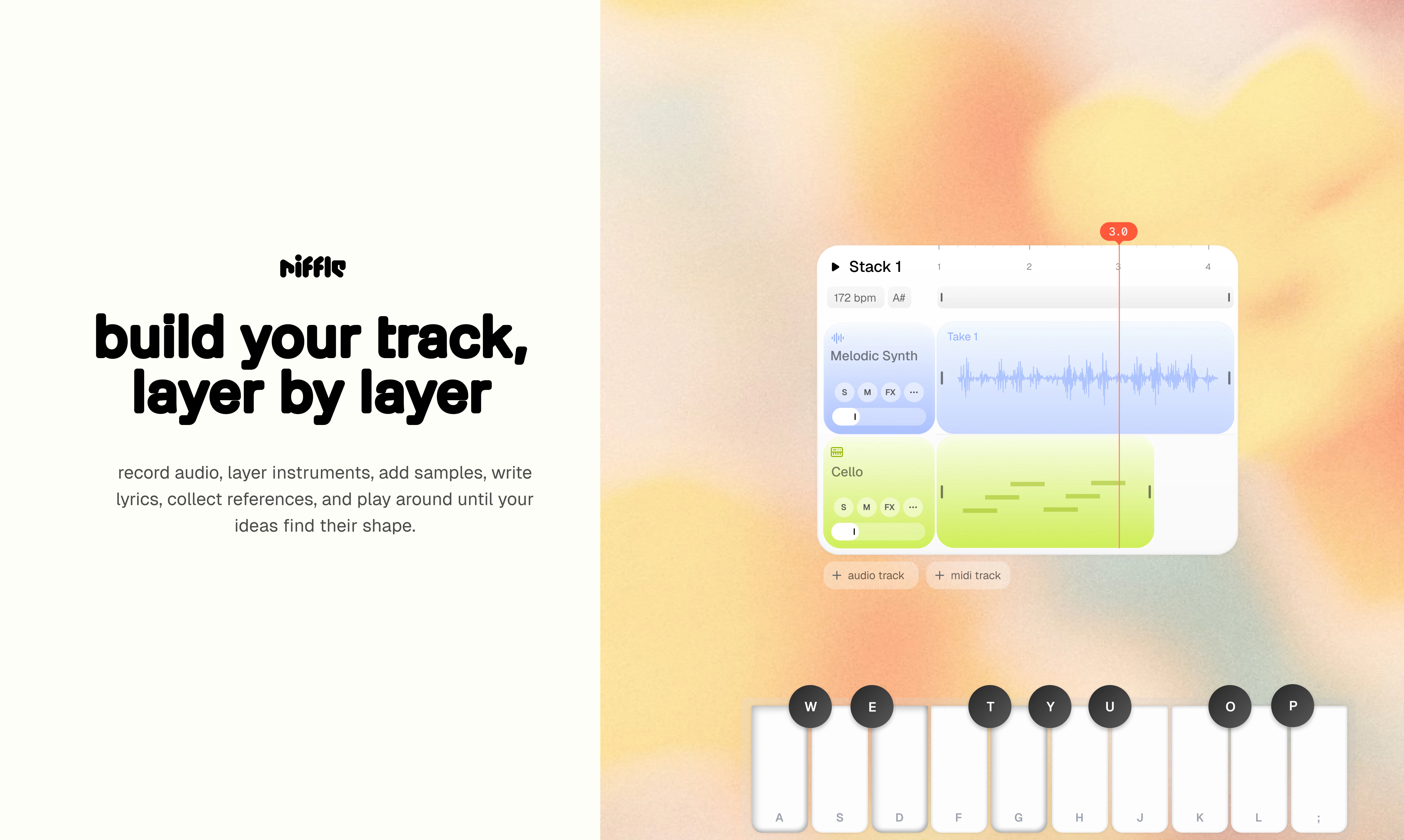
Riffle is a web-based music creation tool built around the metaphor of a playground rather than a studio. You start with a riff. You invite collaborators. You add sample packs, instruments, and audio. And you have access to what they’re calling a “sous chef”, an AI layer that can create, analyze, critique, and guide you through the process.
That sous chef framing is the smartest product decision they made. It positions the AI correctly: not as the chef, not as a co-creator with equal billing, but as the person in the back who helps you figure out what you’re actually trying to cook. It’s a collaborator without being a replacement. I’d expect to see a lot more tools stealing this framing in the next eighteen months.
The “infinite” canvas structure is a real bet. Most DAWs are linear by design because linear is how recorded music is structured. Riffle is pushing against that, which either unlocks something genuinely creative or becomes an organizational nightmare depending on how well the interface holds up. I haven’t been able to stress-test it at scale, and they’re still in alpha, so that’s a question that stays open for now.
The website copy is doing something I don’t see often: it makes a philosophical argument before it makes a product argument. “We think too much and feel too little” is not a feature description. It’s a manifesto. That kind of framing attracts a specific kind of user with a specific kind of frustration, and I think that’s intentional. Spotify’s own moves around music attribution show how much the industry is reckoning with the human element getting lost, and Riffle is fishing in that same emotional water.
It got solid traction when it launched, landing in the top five on Alpha Day.
The co-founders according to LinkedIn are Anurag Choudhary, Mrinali Kamath, and Vinayak Kamath. The Stanford and UC Santa Barbara and Chicago Booth pedigree is there if that’s the kind of thing you care about. I mostly care whether the product works.
The riskiest bet is the “infinite” part. Unconstrained creative tools have a retention problem. Figma survived it because design has deliverables. Music has vibes. That’s harder to sustain.
The Verdict: The Philosophy Is Right. The Retention Problem Is Real.
I think Riffle has diagnosed something correctly. The “soulless interface” problem in music software is real, and the collaborative angle is genuinely underserved. The sous chef AI framing is better than almost anything I’ve seen in this category, and the web-first approach removes enough friction that people might actually show up and try it.
But here’s the thing: inspiration tools have a graveyard problem. People launch them, people play with them for a weekend, and then people leave. The apps that survive in creative spaces are the ones that become part of a workflow, not just a mood. Products that ship into the void without a retention loop rarely make it to year two, and a playground without stakes is hard to return to.
What will determine whether Riffle exists in two years is whether the collaboration mechanic creates actual social obligation. If your friend is waiting on your riff, you come back. If it’s just you and an infinite canvas, you probably open YouTube instead. The multiplayer element isn’t a feature, it’s the entire retention strategy, and they need to build it like it is.
Mrinali Kamath and the team have the background to build something serious here. The alpha is early enough that none of this is a death sentence. But I’d want to see them get obsessive about the moment a second collaborator joins a riff and what happens in the forty-eight hours after that.
My prediction: if Riffle solves the return visit problem, it becomes a genuine cult product in the independent music community within eighteen months. If it doesn’t, it becomes a beautiful demo that everyone remembers fondly and nobody uses.