
















cal-com-agents
AI Agents coming to the best scheduling tool
Cal.com Wants to Make Scheduling the Layer That AI Runs On
The Macro: The Calendar Is Not Solved, Actually
Most people think scheduling software is a finished product. You pick a tool, you share a link, someone books a slot. Done. The category has been “solved” by Calendly since roughly 2013, and nothing that followed changed the fundamental shape of it.
But there is a different question sitting underneath all of that, and it is getting louder: when AI agents start acting on behalf of humans, what do they do about time? Agents can draft emails, run searches, summarize documents. What they cannot do cleanly is manage the messy, permission-heavy, multi-party problem of scheduling without a dedicated layer built for them.
This is not a small market adjacent problem. The productivity software category, across multiple forecasts, is on a trajectory from roughly $62 billion to well over $140 billion by the early 2030s. That growth is not coming from people discovering they need a new to-do app. It is coming from automation, AI workflows, and enterprise tooling absorbing more of what knowledge workers used to do manually.
Scheduling sits right at the intersection of all three. Every agent workflow that involves a human at some point, a sales call, a support escalation, a recruiting touchpoint, eventually hits a calendar. Right now, that handoff is usually clunky. You either drop out of the agent workflow entirely or you rely on some fragile integration bolted on after the fact.
Calendly has been slow to think about this problem from first principles. Reclaim.ai and Motion are focused more on personal schedule optimization than on making calendars readable by autonomous systems. Nobody has really come at this as infrastructure yet, which is the angle Cal.com has been quietly building toward.
The open-source roots matter here. Cal.com was always positioning itself as scheduling infrastructure, not just a booking tool. Agents are the clearest expression of that bet paying off, or not.
The Micro: Chat to Cancel, Chat to Book, Chat to Build
Cal.com Agents is a layer on top of Cal.com’s existing scheduling infrastructure that lets you interact with your calendar through conversation, whether you are a human typing into Slack or an AI agent hitting an API endpoint.
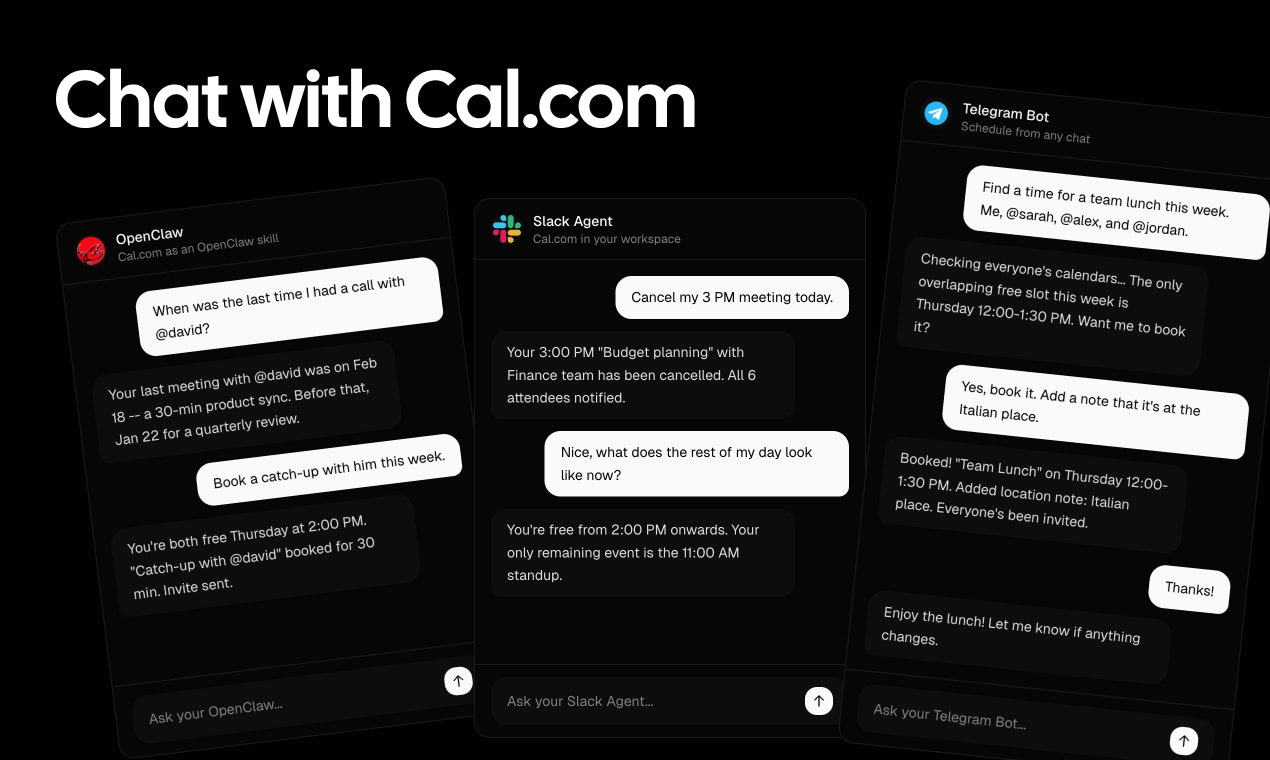
The product ships in two modes. If you are a human, you install the Cal.com agent into Slack or Telegram and start talking to it. The demo on the site shows someone typing “Cancel my 3 PM meeting today” into Slack and getting back a confirmation that all six attendees have been notified. That is genuinely useful and not as common as it should be. Most calendar integrations in Slack still require you to leave Slack.
If you are building an agent, there is an API pathway and a published skill file at a readable URL that you can hand to your agent as context. The docs position this as a “Cal.com skill” your agent can pick up and use. The OpenClaw integration is notable here. OpenClaw appears to be a newer agent platform, and the fact that Cal.com is already compatible with it suggests they are deliberately courting the agent-builder community rather than waiting to see which platforms win.
The split interface design, one path for humans and one for agents, is a real product decision and a smart one. It acknowledges that the use cases are different. A human typing in Slack wants confirmation and brevity. An agent calling an API wants structured data and reliability.
It got solid traction when it launched, which tracks given that Cal.com already has a developer-facing audience primed to care about exactly this kind of extension.
The one thing I kept looking for and could not find is clarity on what happens when scheduling conflicts require judgment. Can the agent negotiate? Can it propose alternatives? The demo shows a cancellation. That is the easy case. I want to see it handle a reschedule request where four people have incompatible calendars.
The pitch is ambitious. The demo is modest. Those two things are not yet reconciled.
The Verdict
I think this is a real bet on a real trend, and Cal.com is better positioned than most to make it. The open-source base gives them credibility with developers. The existing user base means agents have actual calendars to connect to on day one. And the two-sided framing, humans and agents as equal first-class users, is the right conceptual frame for where this category is going.
That said, I would want to see a few things before declaring this more than a well-timed feature launch. Does the Slack agent handle complexity, not just simple cancellations? How does Cal.com prevent the agent from becoming a liability if it misreads an instruction and cancels the wrong meeting? And what does the enterprise permission model look like when an AI agent is touching someone’s calendar on behalf of a company?
The 30-day question is adoption among agent builders, not end users. If OpenClaw and similar platforms start defaulting to Cal.com as their scheduling layer, this becomes infrastructure fast. If it stays a Slack bot for existing Cal.com users, it is a nice addition and not much more.
I have been watching a few products try to own specific slices of the AI workflow stack. Agent 37 is going after cost, ReplylessAI is going after email. Cal.com is going after time. Of those bets, time feels like the one that compounds most when agents scale. The question is whether Cal.com builds the full infrastructure story or just ships the demo.