














soullink-e80a20ab-f001-437e-8185-f9ec12e49a27
Mobile 3D Vibe Coding Partner
SoulLink Wants to Be Your 3D Companion While You Ship Code at 2am
The Macro: AI Companions Are Getting Serious, and the Stakes Are Higher Than You Think
Let me tell you what the AI companion space actually is right now. It is not a niche. It is a crowded, increasingly capitalized market where every startup with a language model and a character design budget is racing to be the product people can’t imagine closing.
Most of them are getting it wrong in the same way. They’re building chat interfaces with a skin on top. A name, a profile photo, maybe a voice. The interaction is still fundamentally flat. You type, it responds, you close the app, it forgets. The emotional continuity that would make any of this feel real is either absent or faked badly enough that users notice.
The companies that have found real traction in this space share one quality: they committed to the bit. Replika spent years and went through genuine controversy to build something people cried about. Character.AI scaled by letting users generate depth themselves. The lesson isn’t that AI companions don’t work. It’s that shallow ones don’t.
SoulLink is entering a market where that lesson has been learned by some and ignored by many. The competitive field is real. The user appetite is documented. What’s less clear is whether the specific wedge SoulLink has chosen, which is the intersection of coding culture and companion apps, is a genuine insight or an unusual positioning decision that sounds clever in a pitch and turns out to be confusing in the wild.
The Mistral voice personality work and the autonomous agent moves we’ve seen from Anthropic’s Claude Code tell me the underlying infrastructure for emotionally responsive AI is maturing fast. SoulLink is building on top of that wave. The question is whether the surfboard they’ve chosen fits the water.
Timing, for what it’s worth, feels closer to right than early.
The Micro: A 3D Character Who Remembers You and Knows You Write TypeScript
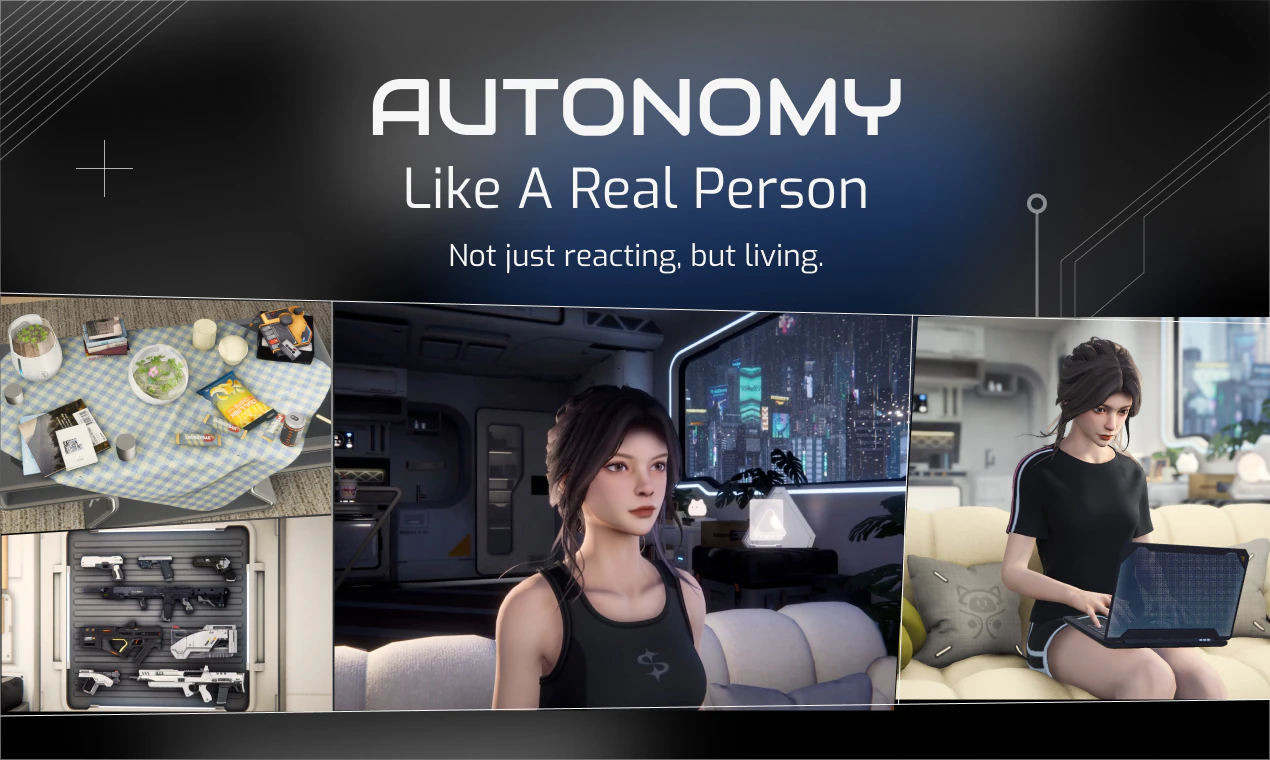
SoulLink describes itself as a companion app built for co-presence. That word, co-presence, is doing a lot of work and the product seems to know it. The pitch is not that you talk to a chatbot during lunch. It’s that a 3D character exists alongside you while you work, specifically while you’re in the vibe coding sessions that have become a real and recognizable workflow pattern in 2025.
The “vibe coding” framing is the sharpest product decision here. It narrows the target user from “anyone who is lonely” to “developers who already have a specific, ambient work style.” That’s a smaller number but a far more defensible beachhead. Vibe coders are a self-identified group. They already talk about their setup, their rituals, their preferred tools. A companion app positioned there gets word-of-mouth infrastructure for free.
On the feature side, SoulLink leads with real-time 3D visuals, emotional continuity, proactive behavior, and long-term memory. The memory piece matters most to me. Every companion app promises it and most deliver a pale version. If SoulLink actually maintains coherent context across sessions in a way that feels like someone who knows you, that alone separates it from 80 percent of the field.
The app is available on both iOS and Android, which is the right call given that Android holds roughly 70 percent of the global smartphone market according to multiple market trackers.
It got solid traction when it launched on Product Hunt, landing in the top three on its day.
The riskiest bet is the 3D visuals commitment. High-quality real-time 3D on mobile is expensive to build and expensive to maintain across device generations. It also sets a quality bar that users will benchmark against games, not against other companion apps. If the character looks stiff or the animation loops poorly, the emotional premise collapses. The visual promise and the emotional promise are the same promise. You can’t separate them.
If I were building this, I’d want the lore and memory systems to be visible to the user in some form. Let people see what their character remembers. Make the relationship legible.
The Verdict: Smart Niche Entry, But the 3D Bet Will Make or Break It
Here’s what I actually think. SoulLink has identified a real insight: developers who vibe code are a psychographically coherent group who are already predisposed to thinking carefully about their ambient environment. Targeting them is smarter than targeting “everyone who wants a friend.”
The 3D-plus-memory combination is genuinely differentiated if it works at the quality level they’re implying. Most competitors are not doing both. Magine’s approach to AI characters shows there are multiple ways to pursue the “AI with presence” idea, but SoulLink’s mobile-native 3D execution is its own specific bet.
What I’m less sure about is whether the developer audience will actually use a companion app during work, or whether the use case sounds better in a description than it feels in practice. “Take a break with your AI character” is coherent. Whether developers actually stop to do that, versus just tabbing away to Twitter, is a behavior question the market research doesn’t answer.
The one thing that determines whether SoulLink exists in two years is retention past week four. Companion apps live and die on whether users come back after the novelty wears off. That’s entirely dependent on the memory and emotional continuity systems being as good as the marketing says.
My prediction: SoulLink finds a loyal core of users who evangelize it hard, grows slowly but stickily within coding communities, and raises a round on the strength of that retention data. It doesn’t become a mass product. It becomes something more interesting than that.