














predflow-ai
Your AI agent for ad performance
Predflow Wants to Be the Ad Manager You Actually Listen To
The Macro: Everyone Has Ad Data. Nobody Knows What to Do With It.
Here’s the thing about performance marketing tools in 2025. There are approximately nine thousand of them, and almost all of them share the same fatal flaw: they give you more information without giving you more clarity. You get a prettier chart. You get a deeper funnel breakdown. You get a Slack notification that your ROAS dropped 14% overnight, and then you sit there wondering what actually caused it and what you’re supposed to do next.
That gap, between data and decision, is genuinely unsolved for most small and mid-sized teams running ads on Meta and Google. The big brands have analysts. Everyone else has a marketing manager with six browser tabs open and a sneaking suspicion they’re wasting budget on something they can’t identify.
Attribution is a particular nightmare right now. Post-iOS 14, the signal quality from Meta in particular took a real hit, and the tools built to compensate have mostly been either too expensive, too technical, or both. I wrote about Spindl building an attribution layer for Web3 marketing, which is a whole separate mess, but the core problem it’s solving, knowing what actually drove a conversion, is exactly what haunts every D2C brand manager running Shopify ads too.
Which, look, the players in this space aren’t sitting still. You’ve got Northbeam, Triple Whale, Rockerbox on the attribution side. You’ve got Madgicx and Motion for creative intelligence. Each one does a slice of what a performance marketer actually needs. The pitch for an AI agent that synthesizes across all of it is obvious. Whether anyone can execute it is a different question entirely.
I’ve been watching the analytics space get noisier by the month. Bear is already trying to build the analytics layer for a world where ChatGPT sends you traffic, which tells you how fast the underlying assumptions are shifting. Any tool that assumes the ad channel mix stays static is probably already behind.
The Micro: Connect Three Accounts, Get Told What’s Broken
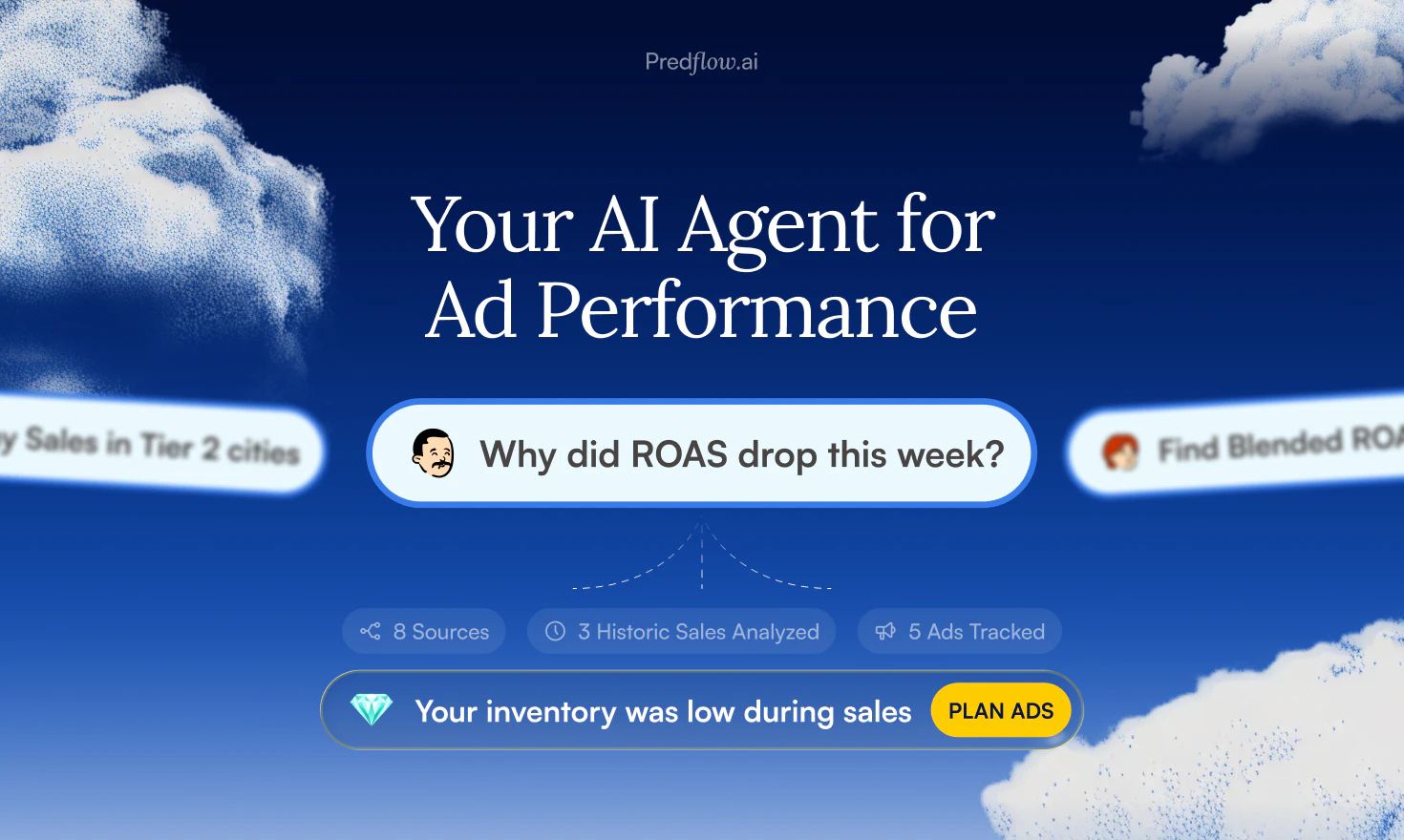
Predflow’s core proposition is pretty clean. You connect Meta, Google, and Shopify, and the AI agent analyzes your ad performance, attribution data, and sales together to tell you three things: what’s happening, why it’s happening, and what to do about it.
That third part is what most tools skip.
The recommendations reportedly cover three areas: creatives, budget allocation, and attribution. So it’s not just flagging that a campaign is underperforming, it’s telling you which specific creatives are dragging it down, whether your spend is distributed the way it should be, and whether the attribution model you’re using is actually reflecting reality. That’s an ambitious scope for a single agent to cover well.
They also have a free ad comparator tool sitting right on the site, which is a smart move. It’s a low-commitment way for someone to get a taste of the product without handing over account access. I’d want to use that before I connected anything to a live ad account.
The brands listed on the site as customers include Suta, Plum, Bummer, and a few others. These appear to be Indian D2C brands, which tells me something about where the product found its early footing. That’s not a knock. India has a massive and fast-growing D2C market, and if you can get attribution right for brands running on Meta and Shopify in that context, the playbook travels.
It did solid numbers when it launched, landing near the top of its category on launch day.
The question I keep coming back to is how much of the “agent” behavior is genuine reasoning versus pattern-matched recommendations. Both can be useful. But they’re different products, and the marketing doesn’t really distinguish between them.
For context on how crowded the adjacent space is, Polymorph is already at 3.5 million users doing analytics work most people haven’t heard of. Predflow is fishing in a competitive pond.
The Verdict
I think Predflow is solving a real problem. The gap between having ad data and knowing what to do with it is genuinely painful for the kinds of teams this product seems built for, and a well-executed AI agent that closes that gap would be worth paying for. I’m not dismissing it.
But I’m also not convinced the hardest parts are solved yet. The pitch is clean. The integrations are the right three. The customer logos suggest real usage. What I can’t tell from the outside is how good the actual recommendations are, whether the attribution analysis holds up when the data is messy, and whether the “agent” framing is more than a UI choice.
Here’s the thing: at 30 days, I’d want to know whether users are actually acting on the recommendations or just reading them and closing the tab. At 60 days, I’d want to see retention numbers. At 90 days, the question is whether they can prove ROAS improvement, because that’s the only metric a performance marketer actually cares about.
If they can show that, this is a serious product. If they can’t, it’s a very well-designed dashboard with a chatbot on top. I genuinely hope it’s the former.